
Mark Carney is not tipping his hand.
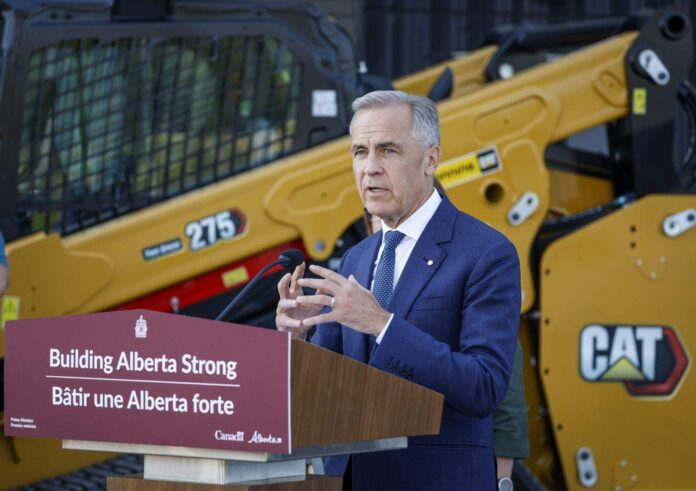
The Prime Minister, appearing in Red Deer, Alberta on Wednesday alongside Premier Danielle Smith for a housing announcement, declined to answer directly when a reporter pressed him on whether Canada would use its energy sector as leverage in ongoing trade negotiations with the United States. The question was blunt — yes or no, would Canadian energy become a bargaining chip? Carney’s answer was deliberate and carefully non-committal.
“We’re engaged in those negotiations to find a mutually beneficial solution,” Carney told reporters. “We’re only going to accept a solution that works for Canadians. We have lots of options of what we would do if that’s not there — but I’m not going to be drawn on what we’re going to do.”
The restraint is calculated. Revealing Canada’s negotiating hand before talks have concluded would weaken the country’s position, and Carney appears acutely aware of that dynamic. Still, the silence carries real weight in a province like Alberta, where the energy sector is not merely an economic abstraction but the backbone of a regional identity and a long-standing source of tension between Edmonton and Ottawa. The question of whether Ottawa would trade away energy concessions — or threaten to restrict energy exports — touches a nerve that runs deep in western Canada.
The backdrop to all of this is a hard deadline. Starting August 19th, the United States will impose 50 per cent tariffs on a range of selected Canadian imports, citing what the White House characterizes as “retaliatory and discriminatory measures” by Canada. The automotive, dairy, and alcoholic beverage sectors are among those in the crosshairs — industries that employ hundreds of thousands of Canadians from Windsor to the Fraser Valley.
Carney had signalled as recently as July 21st that Canada is “looking at all options,” and confirmed that he and President Donald Trump had agreed to intensify discussions. On Wednesday, he struck a tone that was firm without being combative, insisting that Canada would only accept terms that genuinely serve Canadian interests, while leaving the specifics of any potential response deliberately vague. “We’re going to focus now on building towards an agreement, if an agreement is possible,” he said, before adding a pointed observation: “Everybody wants to do more with Canada, except the United States.”
That line carries more than rhetorical weight. It reflects a broader strategic pivot that Carney’s government has been quietly advancing — deepening trade relationships with Europe, the Indo-Pacific, and other partners as a hedge against American unpredictability. Whether that diversification effort can move fast enough to cushion the blow of a 50 per cent tariff wall is another matter entirely. For now, with weeks left before the deadline, the Prime Minister is keeping his options open and his cards face-down.

