Federal Government Eyes Kingston Stop in Revised High-Speed Rail Route
The Liberal government is considering a major route change to Canada’s proposed Alto high-speed rail line that would add a stop in Kingston, Ont., shifting part of the corridor southward toward the shore of Lake Ontario following a public consultation process.
What’s Being Proposed
Transport Minister Steven MacKinnon announced Monday in Kingston that the federal government has directed Alto to evaluate an additional stop in the city — a potential significant departure from the original plan. MacKinnon said he was “acting on what we heard” during three months of public consultations held in roughly two dozen communities this year.
The original Quebec City–Toronto route, announced late last year, included planned stops in Trois-Rivières, Laval, Montreal, Ottawa and Peterborough. So far, the federal government has mandated seven stops: Toronto, Peterborough, Ottawa, Laval, Montreal, Trois-Rivières and Quebec City.
Alto has put forward two route options. The first is a near-straight line between Peterborough and Ottawa. The second is a southern track that brings the line to within a half-hour’s drive of downtown Kingston. MacKinnon said his office would take “a very, very, long, strong and positive look” at the southern option, while stressing no final decision has been made.
The Case for Kingston
According to Alto, adding a Kingston stop would cut travel times between the city and Toronto roughly in half, to approximately 90 minutes. The southern route would also allow the vast majority of residents between Peterborough and Ottawa to reach a station within a 30-minute drive.
MacKinnon said the review was informed not only by public feedback but also by consultations with Indigenous communities conducted between October 2025 and June 2026 along the Toronto–Quebec City corridor.
Kingston city council had previously passed a motion calling on the transport minister to add a Kingston-area stop to Alto’s mandate, and had expressed opposition to the project if no such stop were included. Ontario Premier Doug Ford has also previously backed a southern route along the 401 corridor with a Kingston stop.
A Massive and Contentious Infrastructure Project
The Alto project envisions a roughly 1,000-kilometre all-electric rail line with trains reaching speeds of 300 km/h, at an estimated cost of between $60 billion and $90 billion. Prime Minister Mark Carney has said he wants construction to begin within four years.
Construction of the first phase — linking Montreal and Ottawa — is scheduled to begin in 2029 or 2030, serving as an initial test case for the broader corridor.
The project has faced sustained opposition since its announcement. A grassroots coalition of farmers and small-town residents, particularly in rural eastern Ontario and in Mirabel, Que., has raised concerns about land expropriations and the line’s impact on agricultural properties and communities.
The Budget 2025 Implementation Act included amendments to the Expropriation Act and related legislation to accelerate the federal government’s ability to acquire land for the railway — changes that have deepened opposition among affected landowners.
MacKinnon, who described himself as coming from a farming family, acknowledged the emotional weight of expropriation. “We will not cut corners when it comes to respect; we will not cut corners when it comes to sensitivity,” he said, adding that his preference would be to secure a federal right-of-way rather than full expropriation wherever possible.
Critics Question the Process
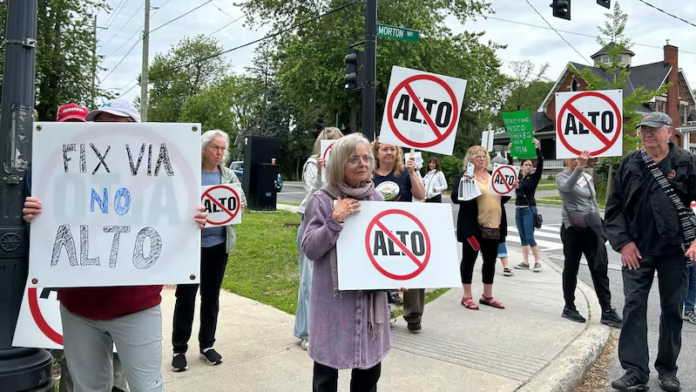
The prospect of an eighth stop drew immediate backlash. Protesters demonstrated outside the Isabel Bader Centre in Kingston where MacKinnon made his announcement, and blocked the exit before police were called to disperse the crowd.
Christian Hébert, president of Quebec’s Union des producteurs agricoles, questioned the project’s planning rigour. “This Alto project is improvisation,” he wrote in a social media post, arguing that Kingston should have been included from the outset if the project rested on a sound business case.
Federal Conservative Leader Pierre Poilievre, speaking in Vancouver, dismissed the project’s viability. “If this project ever gets built it will be 15 years from now and it will cost every family $8,000 in higher taxes,” he said, arguing the funds would be better spent cutting taxes, including the GST on used vehicles purchased through dealerships.
The Parti Québécois has also opposed the project, joining federal Conservatives and rural advocacy groups in criticizing the rail corridor as costly to taxpayers and disruptive to the communities it would pass through.
MacKinnon defended the evolving route, saying the proposed change reflects a clear community preference that emerged through consultation. “This is a strong indication of preference for one route over another,” he told reporters — while reiterating that the final decision has yet to be made.

