A Chaotic Day on the South Lawn and Beyond
The state visit of Chinese President Xi Jinping to the White House descended into a series of physical confrontations and territorial disputes on Thursday, as members of the Chinese press corps accompanying Xi clashed repeatedly with American journalists, White House staff, and Secret Service personnel throughout the day. Videos circulated widely online captured multiple incidents unfolding across different locations on the White House grounds, painting a picture of a press environment that had grown genuinely volatile well before the formal ceremonies concluded.
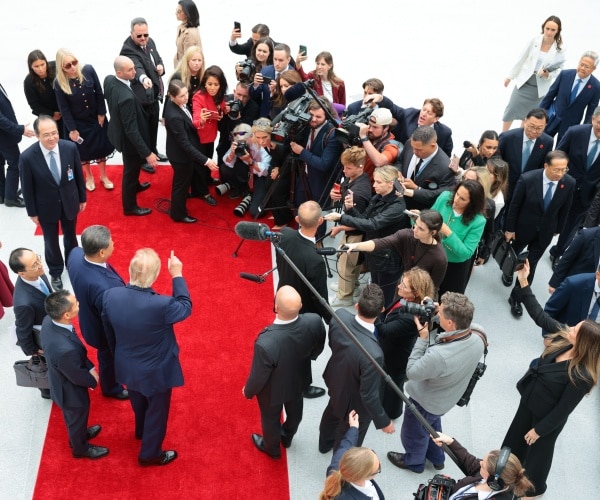
The friction began during Xi’s arrival ceremony and military review in the Rose Garden, where Chinese journalists argued with White House staff and Secret Service agents over where they were permitted to stand. One video captured the crowded, jostling atmosphere as reporters competed for position, with an American journalist audibly telling a colleague, “You’re stepping on my feet.” What might otherwise read as the ordinary chaos of a high-profile state visit quickly escalated into something more serious.
Shoving, Positioning Disputes, and Stern Looks From Cabinet Members
Physical Contact and Altercations Inside the White House
The most striking incidents occurred inside the White House itself, where a male Chinese photographer reportedly shoved a female American reporter as journalists surged through the briefing room doorway ahead of President Trump’s bilateral meeting with Xi in the Oval Office. NTD News White House correspondent Iris Tao described the incident on X, drawing attention to the gendered dimension of the altercation. A separate video showed a confrontation between a Secret Service agent and a Chinese reporter in which the exchange turned physical, with the agent pushing the reporter back and repeatedly instructing him to comply with the established rules of access.
Washington Examiner White House correspondent Christian Datoc reported that Secret Service and White House officials went so far as to threaten the removal of a Chinese official who was interfering with official White House camera positions on the South Lawn — a notable escalation that underscored how far the positioning disputes had moved beyond the ordinary friction of press-pool management. An Epoch Times reporter present throughout the day described repeated confrontations between Chinese camera crews and White House wranglers, including at least one heated argument with a cameraman who refused to comply with staff direction.
Cabinet Officials Drawn Into the Disruption
The disruptions were visible enough to draw the attention of senior administration figures. Daily Wire White House correspondent Mary Margaret Olohan reported that Secretary of State Marco Rubio and Secretary of Defense Pete Hegseth both reacted visibly to the noise and commotion created by the Chinese press corps in the Grand Foyer, repeatedly looking over sternly at the visiting journalists. Olohan drew a pointed distinction in her account, writing that while American journalists are “of course aggressive,” the Chinese press corps was “physically aggressive” and “outright refused to listen to staff and Secret Service” — a characterization that, whatever its rhetorical edge, aligned with the video evidence circulating online.
A Broader Context of Press Access Tensions
The confrontations involving the Chinese press corps unfolded against a backdrop of ongoing tensions over White House press access that have little to do with Xi’s visit. CNN, MSNBC, and Politico reporters found themselves fighting to secure reentry to the White House grounds on the same day, even after a federal judge had temporarily struck down a ban that the Trump administration had originally imposed on certain outlets. Some CNN and MSNBC reporters were ultimately blocked from covering the state dinner for Xi on Thursday evening, adding another layer of complexity to an already fraught day for the White House press corps as a whole.
The incidents also drew renewed attention to an earlier confrontation that had occurred during President Trump’s visit to Beijing in May 2026, suggesting that tensions between the two countries’ press contingents have been building across multiple high-profile diplomatic encounters rather than erupting suddenly and without precedent. President Trump, for his part, reportedly responded to the day’s chaos with characteristic deflection, joking that China had sent the friendliest press corps — a quip that did little to address the structural questions the day’s events had raised about how visiting state media delegations are managed on American soil.
What the Incidents Reveal
At their core, Thursday’s confrontations illuminate the genuine difficulty of managing press access when a visiting government brings its own state-controlled media apparatus, operating under different professional norms and with different incentives than an independent press corps. Chinese state media journalists do not operate within the same framework of editorial independence or institutional accountability that, however imperfectly, governs American journalists’ conduct. That difference in professional culture, combined with the physical intensity of competition for images at a major diplomatic event, created conditions in which friction was perhaps predictable — even if the degree of physical confrontation was not. How the White House chooses to manage such delegations in future visits will likely become a subject of serious internal review.

