A Slowdown That Experts Say Was Preventable
The pace of women reaching senior executive roles is losing momentum, and specialists in leadership development are sounding the alarm. A volatile labour climate, reduced institutional focus, and a persistent shortage of professional infrastructure are compounding what was already a difficult path for women seeking to lead major organizations.
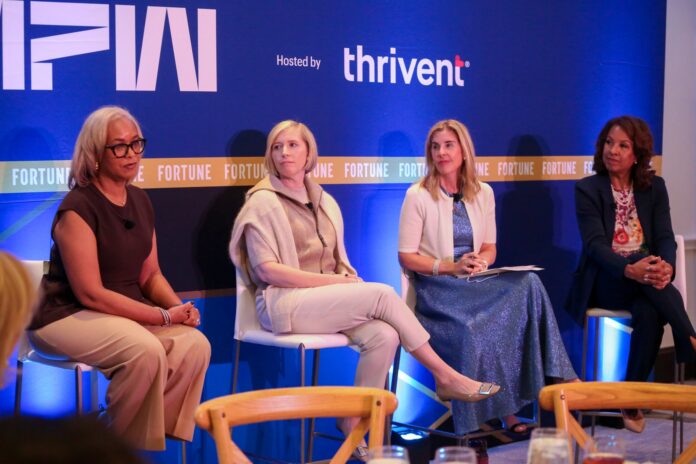
At the Fortune Most Powerful Women Summit in Santa Barbara, Kelly Baker, executive vice president and chief human resources officer at financial services firm Thrivent, put the challenge plainly. Organizations, she argued, have simply taken their attention elsewhere. “If you take your foot off the pedal at all, you will start to stall,” she told Fortune leadership editor Claire Zillman.
The numbers bear that out. Women now lead 56 companies on the Fortune 500 — roughly 11.2% of the list, up from 7.4% six years ago. Yet women’s share of both C-suite and board-level positions has plateaued at around 30%, marking the first decline in women’s board representation in over a decade.
More Than a Pipeline Problem
Toni Townes-Whitley, a former Fortune 500 CEO and Nasdaq corporate board member, pointed to a quieter but consequential shift in the broader conversation. As workplace diversity discussions have faded from prominence, so too has the institutional spotlight on developing women leaders — and with it, she suggested, has come an unsettling recalibration of how women’s capabilities are perceived.
“That’s a concern, underlined, that’s just not talked about,” Townes-Whitley said at the summit, describing a climate in which women face challenges from boards, from external rhetoric, and from within organizations themselves.
The obstacles, however, are not purely structural. Jenna Fisher, managing director at global leadership advisory firm Russell Reynolds Associates, noted that only 36% of women in the workforce have considered or expressed a desire to become a CEO. “We can’t 3D print our candidates,” she said — a pointed reminder that the supply of women who see themselves as future chief executives remains constrained by self-perception as much as by systemic barriers.
Hayden Brown, president and CEO of freelance marketplace Upwork, offered a personal illustration of this dynamic. Despite being raised in what she described as a deeply pro-women household — her mother ran a women’s empowerment program at her workplace — it took her board chair to suggest, roughly a decade ago, that she should pursue a CEO role. Her reaction at the time: genuine surprise.
Brown has since worked to shift those internal scripts, including editing the books she reads with her children to be more gender-inclusive and replacing adjectives like “smart” with “hardworking” to model the qualities she wants them to internalize.
Baker emphasized that meaningful change in the workplace will also require active engagement from men in senior positions — not merely as mentors who support women through their careers, but as sponsors who openly advocate for high-potential women leaders in front of colleagues and decision-makers.
There is, amid the caution, at least one encouraging signal. Fisher noted that the rapid rise of artificial intelligence has created new demand for leaders who are adaptable and technologically fluent — and Russell Reynolds research suggests women are currently ahead of men in AI adoption and implementation. Even as explicit DEI conversations have receded, Fisher argued, the underlying demand for women in executive and board roles remains strong. The challenge is ensuring the systems needed to meet that demand are actually being built.

