No private-sector company has yet agreed to build a new oil pipeline from Alberta to the West Coast. Prime Minister Mark Carney confirmed as much on Tuesday, even as he insisted the broader process is proceeding on schedule.
What exactly did Carney say?
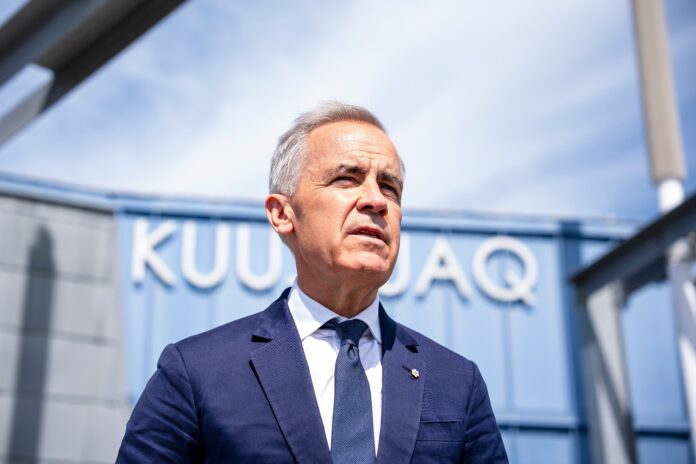
Speaking with reporters in Kuujjuaq, Que., Carney addressed the gap directly. “I’m waiting for there to be a private-sector proponent,” he said in French. “That was the deal. It was in the memorandum of understanding.” He added that his team speaks with Alberta’s government frequently, and that Premier Danielle Smith’s government remains on track to submit a formal pipeline proposal “on or around” July 1 — a deadline set in the MOU the two leaders signed on November 27.
The MOU explicitly references “private sector constructed and financed pipelines,” with co-ownership and economic benefits flowing to Indigenous peoples. The absence of a confirmed proponent heading into that deadline is therefore not a procedural footnote — it goes to the heart of what the agreement requires.
Alberta is slated to announce the details of its pipeline application in Edmonton on July 2, the day after Canada Day, when Carney also plans to be in the city.
Which companies were approached, and why haven’t they committed?
The pattern across all three companies is consistent: technical participation, yes; financial exposure and proponent status, not yet. The commercial conditions that would make such a project viable — stable long-term contracts, regulatory certainty, resolved route questions — have not materialized.
What are the route and regulatory complications?
Alberta’s application is expected to include multiple route options and potential marine terminal locations along B.C.’s northern coast. That region carries significant political and legal weight. A federal moratorium currently prohibits oil tankers from loading and unloading along the northern B.C. coastline — a ban that Coastal First Nations and the B.C. provincial government want kept firmly in place.
Premier Smith has stated a preference for a northern route over a southern alternative, partly because it would reduce sailing time to Asian markets. But that path would require the federal legislation underpinning the tanker ban to be eased or revoked — a move that would face fierce opposition from First Nations along the coast and the provincial government in Victoria. Several B.C. First Nations have already voiced opposition to the draft route maps Alberta released.
Even if Alberta submits its proposal on July 1, Carney made clear that the timeline extends well beyond that date. “There’s a process that takes a few months until October before a decision is made whether or not to refer to the Major Projects Office,” he said, noting that a range of stakeholders must be engaged along the way. The federal government’s recently passed Building Canada Act, under which three northern projects were fast-tracked last week, would likely apply to any approved pipeline — but that designation itself requires a consultation period before a national interest determination can be made.
Is this pipeline connected to other energy deals?
Yes — and Carney was explicit about it. The November MOU committed both the federal and Alberta governments to complete a separate agreement with the Oil Sands Alliance, a group of major energy companies, to fund a large carbon-capture project in the oil sands known as Pathways. That agreement was written into the MOU as a “prerequisite” to any pipeline approval.
“Pathways, the reforms to the carbon market, a potential pipeline, a series of other measures — all aspects of the implementation agreement are linked,” Carney said Tuesday. He did not directly answer when asked whether he had already seen Alberta’s pipeline proposal, saying only: “We’ll wait until the process goes forward.”
What does this mean for Canada’s emissions commitments?
Also on Tuesday, Carney released a 17-minute YouTube video titled Forward Guidance: Canada’s Energy Future, in which he laid out a broader shift in the federal government’s approach to energy policy. He acknowledged plainly that Canada will not meet the short-term greenhouse gas emissions targets set under his predecessor, Justin Trudeau.
“We can’t afford to restrain the growth of an important part of our energy mix — oil and gas — to meet a short-term goal,” Carney said in the video. “The changes we have made will mean that our emissions will be higher in the next few years than they were projected to be under the previous government’s plan.” He argued that Trudeau’s plan would have been too costly for consumers, too damaging to trade relationships, and too politically divisive to sustain.
Canada’s emissions targets are enshrined in the Canadian Net-Zero Emissions Accountability Act and tied to the country’s commitments under the Paris Agreement. Carney’s remarks signal that the federal government is recalibrating how it balances those long-term climate obligations against the immediate economic and political pressures of expanding conventional energy infrastructure — a tension that the West Coast pipeline question makes unavoidably concrete.

