
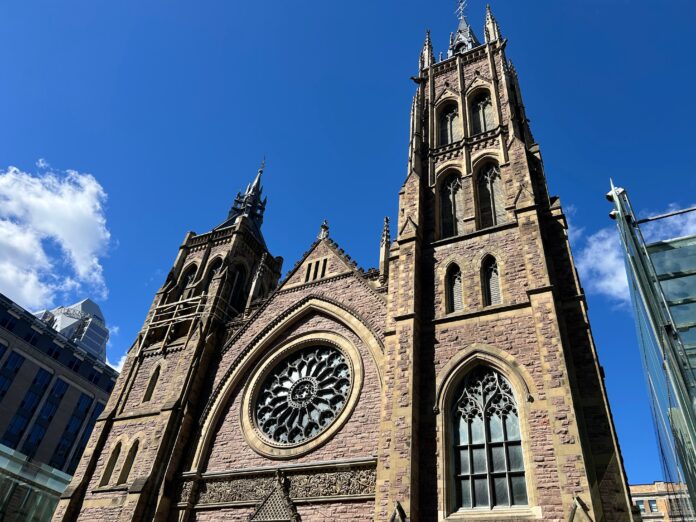
It has survived wars, economic collapses, and the steady drift of congregations away from downtown cores. Now, St. James United Church — one of Montreal’s most storied religious and civic landmarks — faces a threat that may prove harder to outlast: the slow, expensive reckoning of deferred maintenance and dwindling resources.
The Reverend Arlen Bonnar, who leads the congregation, describes the situation without euphemism. “We are in a bit of a crisis situation now with regard to our financial situation,” he said. The problems are both visible and structural — chandeliers that no longer function, steps in disrepair, and a deteriorating tower that demands urgent attention. “A stone can move and cost us a half a million dollars,” Bonnar noted. “Gotta be done. But we’re now at the point where we don’t have the resources to do that anymore.” The full scope of repairs, he says, will run into the millions.
What makes the financial picture especially tangled is the web of public and institutional obligations surrounding the building. St. James United receives funding from both the federal government and the Government of Quebec, which have each granted the church heritage status — a recognition that brings prestige and some support, but also layers of bureaucratic complexity when it comes to determining who bears responsibility for which repairs. “It’s complex,” Bonnar said, in what may be something of an understatement.
The heritage designation is not merely ceremonial. Taika Baillargeon of Heritage Montreal points out that the church’s Gothic Revival architecture draws thousands of tourists to Sainte-Catherine Street every year, and that the building carries deep historical significance for the city and for Canadian Protestantism more broadly. “It represents a really important period of Methodism in Montreal,” Baillargeon said. “When it was built, it was the largest Methodist church in Canada.” That distinction speaks to an era when Montreal was not only Canada’s commercial metropolis but also a city of considerable religious and cultural ambition — a history that the building’s soaring stonework still communicates, even as that stonework crumbles.
Yet for Bonnar and for the Montrealers who have passed through its doors across generations, St. James is something more than an architectural artifact. When the September 11 attacks left thousands of Americans stranded in Canadian cities, the church opened its doors to those seeking shelter and comfort. After the 2006 shooting at Dawson College shook the city, St. James became a gathering place for collective mourning. “It’s a place where people can come and be welcomed and find security,” Bonnar said. These are not incidental details — they speak to a role that few institutions, religious or otherwise, have managed to sustain in the middle of a rapidly changing urban core.
Bonnar has called a special congregational meeting for Sunday, where he hopes to identify a partner — whether institutional, governmental, or private — willing to commit resources before the structural damage deepens further. The urgency is real: heritage buildings do not wait for funding cycles to align, and deferred maintenance has a way of compounding costs faster than any restoration budget can absorb. CTV News reached out to Parks Canada and Quebec’s Ministry of Culture for comment but received no response before publication.
The broader question hanging over St. James is one that many Canadian cities are quietly confronting: who bears responsibility for preserving buildings that have become part of a community’s shared memory, when the institutions that built them can no longer carry the weight alone? Heritage status confers recognition, but recognition does not fix a crumbling tower. The answer, if there is one, will likely require the kind of collaborative effort — federal, provincial, municipal, and civic — that the building’s own history suggests is possible, if rarely easy.

