
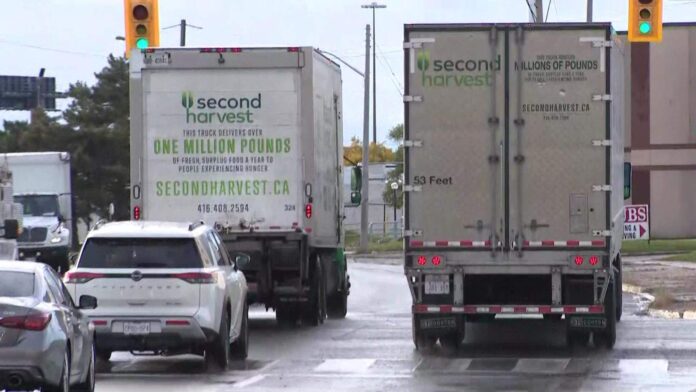
Canada’s largest food rescue organization has found a measure of relief after a deliberate and costly attack on its fleet — but the incident lays bare just how vulnerable essential community infrastructure can be. Second Harvest, which redirects surplus food to non-profits feeding Canadians from coast to coast, received a $60,000 donation from Aurora Importing this week after thieves stripped catalytic converters from seven of its trucks at its Toronto yard. The donation is welcome. It is not quite enough.
A Targeted Attack at the Worst Possible Moment
The vandalism occurred on a Sunday, just days before Second Harvest was set to run its annual Thanksgiving turkey giveaway. Suspects cut through the perimeter fence and methodically removed the catalytic converters from seven vehicles, rendering the entire affected portion of the fleet inoperable. Only two trucks remained road-ready.
This was not opportunistic mischief. Second Harvest CEO Lori Nikkel described it as “a far more organized crime” than a previous incident on New Year’s Eve, when water was poured into the organization’s fuel tanks — an attack that had already prompted the installation of that fence. The perpetrators knew what they were doing, and they knew where to do it.
The timing compounded the damage. Nikkel said demand for food support was already “overwhelming” before the trucks went down. Losing seven vehicles in a single night did not just disrupt logistics — it directly threatened deliveries to communities that depend on Second Harvest’s network to eat.
Community Response Fills Part of the Gap
The $60,000 pledge from Aurora Importing, announced Wednesday by company president Joe Moscato, represents a significant act of corporate civic responsibility. Moscato framed it plainly: the obligation of a food company does not end at the grocery shelf. It extends into the communities those shelves serve.
Nikkel estimates total repair costs at $80,000. The donation closes most of that gap. It does not close all of it, and the repairs themselves are expected to take two to three weeks — weeks during which Second Harvest’s capacity remains constrained.
Beyond the cheque, Nikkel noted that Toronto residents responded in kind: volunteers arrived with their own trucks, others brought food and funds. That outpouring matters, both practically and symbolically. It reflects the kind of civic solidarity that sustains food security infrastructure when institutions fall short.
The Investigation and the Broader Question
Toronto police confirmed Wednesday that the investigation remains active. Officers released images of a black Infiniti G25 four-door sedan with black rims, identified as the vehicle the suspects used to flee the scene. Police are seeking one or more individuals and are asking anyone with information to come forward.
The theft of catalytic converters has become a serious and growing problem across Canadian cities, driven by the high resale value of the precious metals they contain. That Second Harvest — an organization explicitly serving the public good — was targeted twice in less than a year points to a pattern that goes beyond bad luck. It points to a security gap that charitable organizations, operating on tight margins, are structurally ill-equipped to close on their own.
The generosity of Aurora Importing and the Toronto community saved Second Harvest’s Thanksgiving operations. That is genuinely good news. But the deeper implication is harder to shake: if organizations like Second Harvest must rely on private donors to recover from preventable crimes, then the systems meant to protect them — physical, legal, and institutional — are not doing enough.

