
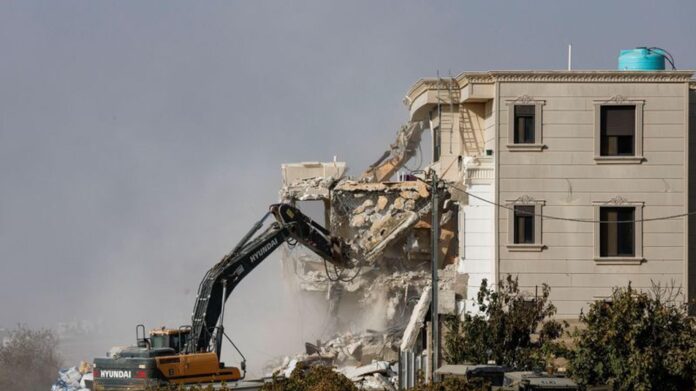
The Israeli military’s large-scale operation in Hebron, which has displaced more than 1,200 Palestinians from their homes in the occupied West Bank, raises a question that cannot be easily dismissed: is this a legitimate security response, or does political timing transform it into something more troubling? The evidence available suggests that while the immediate trigger — the killing of two Israeli soldiers at a checkpoint — is real and serious, the scale and character of the operation reflect pressures that extend well beyond security imperatives, including a parliamentary election days away that could cost Benjamin Netanyahu his governing majority.
A Security Operation With a Political Shadow
The sequence of events began on Friday when two Palestinian gunmen opened fire at a military checkpoint near Hebron, killing two Israeli soldiers before being shot dead themselves. Netanyahu moved quickly, announcing a large-scale military operation targeting the Al-Jaladah and Ein Deir Baha neighbourhoods near the checkpoint entrance. The stated objectives were to search for militants and weapons and to carry out demolitions — a combination that the Palestinian Authority wasted no time in condemning as collective punishment. That phrase carries legal weight under international humanitarian law, which prohibits penalizing a civilian population for acts it did not individually commit.
Yousef Zouhair Al-Jabari, the head of Hebron’s municipality, reported that roughly 1,200 residents had already been forced from their homes, with an additional 1,300 facing the same prospect. Residents described to Reuters a military presence that expelled people with no apparent connection to the attackers. Majdi Nasser, one of those driven out, put it plainly: “There are children. We are isolated; we don’t do anything. This is all arbitrary.” Soldiers were also observed marking evacuated homes with a black X — the significance of which Israeli authorities have not explained. The Palestinian Prisoners’ Club, an NGO, reported approximately 70 arrests over Friday and Saturday, a figure Israeli officials have neither confirmed nor denied.
Al-Jabari went further, arguing that the timing of the operation is inseparable from Tuesday’s parliamentary elections, in which opinion polls suggest Netanyahu’s right-wing coalition may lose its majority. “Netanyahu and the radical ministers in his government are trying to win as many votes as possible from the settlers,” he said. This is a serious allegation, and it deserves serious scrutiny rather than reflexive dismissal. Democratic governments are not immune to the temptation of security theatre, and the acceleration of settlement expansion under the current government — deemed illegal by United Nations bodies and the vast majority of states, though Israel contests this — provides a relevant backdrop for evaluating the claim.
A West Bank Under Mounting Pressure
The Hebron operation does not exist in isolation. Across the West Bank, Israel has blocked the entrances to most Palestinian cities and towns, imposing sweeping restrictions on freedom of movement that affect ordinary life in ways that compound daily hardship into something systemic. The human cost is not abstract. Yousef Mur, a resident of the Palestinian town of Yatta, described attempting to bring his daughter to Jerusalem for cancer treatment and being turned back. “When we tried to cross, they fired stun grenades towards us, and my girl got scared on the way,” he said. “The situation is very difficult.” That a child undergoing cancer treatment cannot reach a hospital is not a minor operational inconvenience — it is a measure of how deeply these restrictions cut into Palestinian civilian life.
Netanyahu’s government has overseen a rapid and documented expansion of settlements across the West Bank, a policy that has drawn sustained international criticism and that shapes the political economy of the occupation in ways that make operations like Hebron’s more likely, not less. Demolitions, displacement, and movement restrictions are not isolated incidents but recurring features of a governance framework that the Palestinian Authority and most of the international community regard as incompatible with any durable resolution. Whether one accepts or disputes that framing, the facts on the ground — 1,200 displaced, hundreds more threatened, a cancer patient turned back at a checkpoint — demand clear-eyed accounting rather than euphemism.
The central question raised by the Hebron operation is not whether Israel has the right to respond to the killing of its soldiers. It plainly does, and the attack at the checkpoint was a lethal act of violence. The question is whether the response is proportionate, lawful, and free from the distorting influence of electoral politics. On all three counts, the evidence available gives serious reason for concern. When military operations are launched days before an election, target entire neighbourhoods rather than identified combatants, and result in the displacement of over a thousand civilians, the burden of justification falls heavily on those who ordered them — and that burden has not yet been met.

