
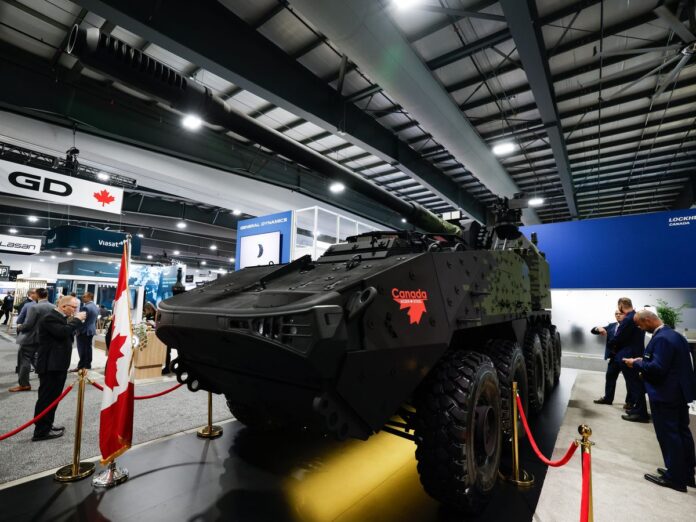
The factory floor in London, Ontario hums with the kind of industrial purpose that defence planners and economic strategists rarely manage to align. On Thursday, Prime Minister Mark Carney stood inside the General Dynamics Land Systems-Canada facility and announced what his government is calling the first concrete expression of a new approach to Canadian defence — one that ties military procurement directly to domestic industrial capacity.
The federal government intends to spend nearly $2 billion over the next four years to add 190 armoured combat support vehicles to the Canadian Armed Forces’ fleet, bringing the total from 360 to 550 vehicles. Every one of those vehicles will be assembled at the London plant, with components sourced from suppliers across the country — a deliberate architectural choice that transforms a military contract into a national industrial project.
Carney described the deal as the first strategic partnership under Ottawa’s defence industrial strategy, unveiled in February, and the first to operate within the government’s new strategic partnership framework. “Today’s announcement is our defence industrial strategy in action,” he said. “Our bold plan to get our Armed Forces what they need, when they need it, to scale Canadian defence companies and to put hundreds of billions of dollars to work in the strategic sectors of our economy. We have a simple framework: build, partner, buy.”
The partnership tasks General Dynamics Land Systems-Canada with designing, building, delivering, and sustaining the next generation of armoured combat vehicles on Canadian soil. According to the Prime Minister’s Office, the arrangement will create and sustain more than 6,000 high-paying jobs annually over the next eight years, counting workers already employed at the facility.
Those jobs extend well beyond London. Ryan Manufacturing in Richmond, B.C., will supply military-grade cable and wire harness assemblies. Interpro in Regina will produce advanced armour. Thales Canada in Saint-Laurent, Quebec, will provide thermal imaging systems. IMP Aerospace and Defence in Enfield, Nova Scotia, is among the other contributors whose components will converge at the London assembly plant. The supply chain is deliberately national in scope, a structure that reflects both industrial logic and the political reality of governing a federation where regional economic stakes matter.
The vehicles themselves — known as armoured combat support vehicles, or ACSVs — come in eight functional variants: ambulance, command post, troop and cargo transport, electronic warfare, maintenance and recovery, mobile repair team, fitter and cargo, and engineer. All are built on the Light Armoured Vehicle 6.0 platform, a design choice that reduces training demands and sustainment costs while keeping more of the fleet operationally available at any given time.
This is not General Dynamics’ first chapter in Canada’s defence story. Ottawa purchased 360 armoured vehicles from the company in 2019, with delivery scheduled for completion by the end of 2025, and General Dynamics Land Systems-Canada has supplied armoured vehicles to the Canadian government since the late 1970s. The relationship is long-standing, though the current strategic partnership framework represents a more formal and explicitly industrial dimension than previous procurement arrangements.
The vehicles are already doing operational work. ACSVs are deployed with the Canadian-led NATO Multinational Brigade in Latvia under Operation REASSURANCE. Canada has also donated 89 of these vehicles to Ukraine, with a further 35 committed at the 2026 NATO Summit, as part of more than $8.5 billion in Canadian military assistance to Ukraine — a figure that underscores how central this particular platform has become to Canada’s defence commitments abroad.
Thursday’s announcement fits within a broader pattern of high-profile military investments that the Liberal government has made in recent months. Canada has joined a joint procurement project with ten other NATO countries to acquire up to ten of Saab’s GlobalEye surveillance aircraft. A contract with German shipbuilder ThyssenKrupp Marine Systems will replace Canada’s aging submarine fleet with up to a dozen new vessels, a deal expected to exceed $100 billion when maintenance costs are included. Taken together, these commitments signal a sustained shift in the scale and ambition of Canadian defence spending.
Defence Minister David McGuinty, who joined Carney for the announcement, framed the investment in terms of sovereignty and alliance credibility. Canada, he said, “can’t afford to stand still,” and the strength of the Canadian Armed Forces depends on the country’s ability to build what its military needs at home rather than relying entirely on foreign suppliers. That argument — that defence procurement and industrial self-sufficiency are inseparable — runs through every element of the government’s stated strategy.
Canada is reaching NATO’s two-percent defence spending target for the first time since the fall of the Berlin Wall, according to the Prime Minister’s Office, and has secured more than twenty defence and security partnerships in a single year. Whether the pace of these commitments translates into the operational readiness and industrial depth the government promises is a question that will take years to answer — but the factory floor in London, Ontario, is where that answer begins to take shape.

