Home Blog Page 24

Montreal strippers plan F1 weekend strike to demand better working conditions and decriminalization of sex work

0

Montreal strippers plan F1 weekend strike to demand better working conditions and decriminalization of sex work

Montreal sex worker and organizer Adore Goldman is leading a strike on the second day of Formula 1 weekend — one of the city’s busiest periods for adult entertainment — to demand stronger labour protections for strippers and erotic massage parlour workers, and to push for the decriminalization of sex work.

Strike timed to maximize visibility

Members of the Sex Work Autonomous Committee (SWAC) have organized the action for Saturday, when clubs are typically packed with F1 visitors. Participating strippers have marked themselves as unavailable to their managers.

After a march through downtown Montreal, demonstrators plan to split up and distribute flyers outside various venues, sharing their demands with patrons, passersby, and other strippers heading into work.

Independent contractor status at the heart of the dispute

The vast majority of Canadian strippers are classified as independent contractors — an industry-wide norm that Goldman says shields club owners from accountability over unsafe working conditions.

“Being recognized as an employee, your employers have to guarantee your safety and your mental health at work,” she told CBC. “Like sexual violence that happened in the clubs in the past, if we were employees, the person could get compensated if it was a work accident — because it is a work accident.”

CBC granted Goldman’s request to use her professional name rather than her legal name due to safety concerns related to her clients.

Bar fees cutting into already thin earnings

A central grievance is the “bar fee” clubs charge dancers simply to work a shift. These fees typically range from $15 to $100 and are sometimes raised during F1 weekend — even though the event does not necessarily translate into higher earnings per dancer.

“There might be more clients, but there’s no more clients per stripper. So it’s not that profitable for us, but it is for the employers,” Goldman said, pointing to club owners’ practice of over-scheduling on busy days.

A Montreal student and filmmaker who strips says she pays around $60 in bar fees on regular shifts, not including customary tips to bouncers and DJs. “Usually $100 total to work on weekends at my club, and then also transportation there and back,” she said. “I have left in the negative and it’s always in the winter.” CBC is withholding her identity because she fears losing her job over her union activities.

Some in the industry argue bar fees help offset costs such as music licensing, locker room upkeep, and electricity.

A legal grey zone with real consequences

Canada’s sex industry operates under a contradictory legal framework: selling sexual services is legal, but purchasing them can expose clients to criminal prosecution. This creates an uneven landscape where workers bear the greatest risk.

Not all strippers sell what the law defines as “sexual services,” and not all identify as sex workers. But Frances Shaver, professor emeritus of sociology at Concordia University, says the stigma attached to sex work affects all workers in the industry regardless of what they actually do.

“That’s why the process of legitimizing sex work becomes really important,” Shaver said.

Violence and lack of training on the job

Goldman says she experiences unwanted physical contact on virtually every shift. “I have clients trying to touch me in inappropriate places, even take their penis out,” she said. “Sometimes you have to get into an argument. I had a customer who bit my boob. I’d say every shift there’s something that happens that I don’t consent to.”

The filmmaker says she never received any training on how to handle unruly clients and has taken it upon herself to train new strippers entering the scene.

Unionization as a path to decriminalization

Goldman and SWAC’s longer-term goal is to form a union grouping all types of sex workers — strippers, erotic massage workers, and escorts — to build collective bargaining power and create legal pressure on the government to decriminalize sex work.

Shifting workers from independent contractor to employee status would be a key first step, making unionization legally easier to pursue.

Geographic monopoly limits workers’ options

Not all strippers have the ability to strike. Unlike most industries, leaving one club for another in Montreal is not straightforward. Erotic establishments are banned in most of the city’s boroughs, and those that permit them restrict them to specific zones that can be difficult to reach by transit.

Opening a new strip club requires special alcohol permits and public consultations, creating significant barriers to entry. “This makes it so there’s even more competition between each other, and the clubs have like a monopoly,” Goldman said.

Federal government not moving on decriminalization

In a statement to CBC, the federal Department of Justice said it “acknowledges that these issues prompt strongly held views, but full decriminalization is not something that is being considered at this time.”

CBC made multiple attempts to reach various Montreal strip clubs for comment and received no response.

Sixties Scoop Survivors Reunite in Winnipeg After Decades of Separation

0

Three siblings separated by the Sixties Scoop meet in person for the first time

Three Indigenous siblings torn apart by the Sixties Scoop have reunited in Winnipeg, decades after the Canadian child welfare system removed them from their family — including one sister who flew in from Oregon after only recently learning her family had been searching for her.

Melody Roberts, 66, of Eugene, Oregon, embraced her biological siblings Joe Lambert and Donna Morin, 61, on Sunday evening at Winnipeg’s Richardson Airport, where a welcoming party greeted her with signs, singing, and drumming at the arrivals area.

“It’s good to be back,” Roberts said at the reunion.

A family pieced back together, one name at a time

It was Morin who drove the search. She recalled a story her grandfather had told her years earlier — that he had taken their pregnant mother to the hospital, but that “she’d come out without children.”

“I just thought she left them there, and then I heard about the Sixties Scoop,” Morin said. “I got a list of the children that she had lost. And so I found most of them. I only had [Joe] and Melody to find — and I finally found them.”

The reunion was made possible through the help of Susanna Tasse, social services and outreach co-ordinator with Winnipeg charity Hope Centre Ministries. Tasse said the process began roughly a year and a half ago when she realized Lambert — one of her clients — was also a Sixties Scoop survivor.

The scale of the Sixties Scoop in Manitoba

The Sixties Scoop refers to the widespread practice of removing Indigenous children from their families and communities and placing them with non-Indigenous adoptive or foster families — often with no connection to their culture, language, or identity.

A provincial inquiry in Manitoba, completed in 2015, found that more than 3,400 Indigenous children were “shipped away” to adoptive parents between 1971 and 1981 alone, with some sent to other countries.

Tasse said the lasting damage of that separation runs deep. “Survivors grew up thinking they were not wanted,” she said. “There’s abandonment issues all their lives because they felt they were not wanted.”

Three days together, a lifetime to catch up on

Roberts spent three days in Winnipeg with her siblings, visiting The Forks and looking through family photographs for the first time.

“We just got done looking at a bunch of pictures of my family and my other brothers and sisters and my mom and dad,” Roberts said during a phone interview on Monday. “It’s been really awesome. I’m really enjoying myself here.”

Quebec Premier Faces Questions in Paris Over Suspended Fast-Track Immigration Program

0

Quebec Premier Faces Questions in Paris Over Suspended Fast-Track Immigration Program

Quebec Premier Christine Fréchette was questioned by a French member of parliament during a diplomatic mission in Paris about her government’s plans to reopen the Programme de l’expérience québécoise (PEQ), a popular fast-track immigration pathway that was shut down under her predecessor.

What Is the PEQ?

The PEQ had been one of Quebec’s most widely used routes to permanent residency, designed for foreign nationals who had already studied or worked in the province. Its two streams — the Quebec Graduates stream and the Temporary Foreign Workers stream — were suspended in October and June of 2024, respectively, before the program was officially closed on November 19, 2025, under former premier François Legault.

The closure formed part of Quebec’s 2026–2029 Immigration Plan, which capped annual permanent residency admissions at 45,000 across all provincial programs.

Fréchette’s Promise to Reopen

Fréchette, who served as Quebec’s Minister of Immigration, Francization, and Integration from 2022 to 2024, made reopening the PEQ a central pledge of her Coalition Avenir Québec (CAQ) leadership campaign. She also promised to grant an exemption to immigrants already living in Quebec when the program was abolished.

In her inaugural address to the National Assembly on May 5, she announced the PEQ would reopen for a two-year period. “While respecting our immigration thresholds, we must allow those who already speak French and who are already integrated to have as much predictability as possible,” she said.

Uncertainty Persists for Applicants

Despite the announcement, Fréchette has not specified when the program will reopen or whether its eligibility criteria or application process will change — leaving thousands of would-be applicants in limbo.

Immigration lawyer Yves Martineau said the announcement has generated as much anxiety as relief. “At this point, there is more anxiety than joy because there has been a lot of uncertainty,” he said, adding that his firm has been flooded with inquiries.

Without a clear start date, critics warn many immigrants will be forced to leave Quebec before they can even apply. Martineau said several of his clients have already relocated to other provinces or are preparing to do so.

Advocacy Groups and Federal Pressure

Advocacy group Le Québec, c’est nous aussi (LQCNA) has called for a direct meeting with new Immigration Minister François Bonnardel, urging the government to find concrete solutions for families and students who relocated to Quebec in response to the province’s own recruitment needs, only to have their path to residency eliminated.

Bonnardel’s office said it is “actively working on various scenarios” to reopen the PEQ and that details will be provided “shortly.”

On the federal side, Ottawa has granted 12-month extensions for closed work permits. Quebec is pressing the federal government to go further, requesting that renewals also be extended to open work permit holders, spouses, and dependents.

NDP Leader Avi Lewis Takes Party Rebuild Tour to Saskatoon

0

Federal NDP leader Avi Lewis addressed a packed crowd in Saskatoon as part of an ongoing tour aimed at rebuilding the party following its reduced showing in the most recent federal election.

Details of the event, including the specific policy messages Lewis delivered and the size of the audience in attendance, were not immediately available from the source material.

The tour signals the NDP’s intent to re-engage supporters across the country, including in the Prairie provinces, where the party has historically faced an uphill battle against Conservative dominance.

Saskatchewan, long a province with deep social democratic roots — the CCF, the NDP’s predecessor, was founded there — has in recent decades trended strongly toward the Conservative Party federally, making Lewis’s outreach to Saskatoon audiences a notable strategic choice.

Further details on the party’s rebuild strategy and the substance of Lewis’s remarks are expected to emerge as the tour continues.

Canada and Alberta Strike Carbon Deal to Fast-Track 1-Million-Barrel-Per-Day Pipeline

0

Canada and Alberta Strike Carbon Deal to Fast-Track 1-Million-Barrel-Per-Day Pipeline

Prime Minister Mark Carney and Alberta Premier Danielle Smith announced a landmark carbon pricing agreement on Monday that could pave the way for construction of a major new oil pipeline to the British Columbia coast — with a start date as early as September 2027.

What the Deal Does

The agreement sets out a revised industrial carbon pricing schedule and, for the first time, establishes a concrete timeline for a pipeline capable of carrying one million barrels per day of Canadian crude to Pacific tidewater for export to Asian markets.

Under the deal, Alberta’s industrial carbon price will rise from its current $95 per tonne to $100 per tonne by the end of this decade, then increase by $3 per year to reach $130 per tonne by 2040. That represents a significant rollback from the previous Liberal government’s target of $170 per tonne by 2030.

The pact builds on a memorandum of understanding signed last November, in which Ottawa agreed to fast-track federal review and designate the pipeline as a project of national interest, contingent on Alberta meeting certain emissions-reduction conditions.

A Timeline — But No Pipeline Company Yet

Alberta has committed to submitting a formal pipeline proposal by July 1, with Ottawa pledging to fast-track its review. Construction could begin as early as September 2027.

There is, however, a significant gap: no private-sector proponent has formally stepped forward to build the pipeline. The project’s viability ultimately depends on a company willing to take it on.

Political Reactions Are Sharply Divided

The deal has drawn criticism from both the left and the right. NDP Leader Avi Lewis called it “the Carney government’s official surrender to the oil and gas lobby,” arguing the revised carbon pricing schedule dismantles the last meaningful federal climate measure.

Conservative Leader Pierre Poilievre said he supports building a pipeline but opposes any increase to the industrial carbon price, declaring: “Conservatives want a pipeline without a carbon tax, not a carbon tax without a pipeline.”

Environmental groups warned the agreement significantly weakens Canada’s industrial carbon pricing regime. They note the effective market carbon price will reach only $60 per tonne in 2030 — far below the $170 target originally set for that year — rising to $110 per tonne by 2040.

Energy Analysts See Cause for Cautious Optimism

Some in the energy sector welcomed the announcement. Richard Masson, former CEO of the Alberta Petroleum Marketing Commission, called it a “very positive step,” saying it checked off another condition from last fall’s memorandum of understanding.

Kevin Birn, chief oil analyst for Canadian markets at S&P Global, said the announcement could bring greater clarity to companies considering investment in Canada’s oil sector — a market that has long struggled to attract pipeline infrastructure capital.

A Long-Delayed Reckoning

Canada has wrestled for years with how to expand oil export capacity while meeting climate commitments — a tension that has produced legal battles, constitutional disputes, and stalled projects.

The Carney government has framed federal pipeline support as contingent on industry emissions reductions, attempting to link infrastructure expansion directly to climate accountability. Whether that balance satisfies critics on either side remains to be seen.

With a formal proposal deadline set and a construction window identified, Canada is closer than it has been in years to turning a long-debated pipeline corridor into an actual project — provided a builder emerges to take it on.

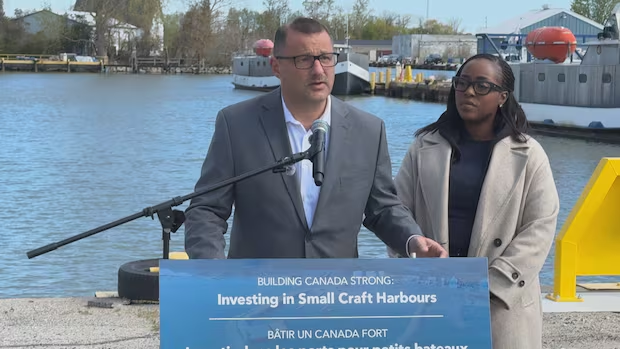
Federal Government Pledges Harbour Funding for Wheatley and Erieau, but Final Figures Still Unknown

Federal Government Pledges Harbour Funding for Wheatley and Erieau, but Final Figures Still Unknown

The federal government has announced that two southwestern Ontario fishing harbours — Wheatley and Erieau — will receive a share of a $957.8 million national investment in small craft harbours over five years, but the exact amounts earmarked for each site remain undetermined while the work is put out to tender.

What the Money Is For

The funding comes through Fisheries and Oceans Canada’s Small Craft Harbours Program, announced as part of the federal government’s spring economic update. The program is intended to fund repairs, upgrades, and dredging at harbour facilities across the country, with infrastructure built to meet current climate projections.

At Wheatley Harbour, home to 59 commercial fishing vessels, the planned work includes encapsulating the East Pier in steel, constructing a new concrete deck, and dredging the Entrance Channel and Sediment Sink. At Rondeau (Erieau) Harbour, which supports 25 commercial fishing vessels, the funds will go toward rehabilitating Breakwater 303 and Basin 201.

A Long-Standing Safety Problem

Boats running aground at Wheatley Harbour have been a documented safety concern for more than a decade. Fishers and harbour advocates have repeatedly called on the federal government to make a capital investment rather than continuing to fund repeated dredging exercises.

Vald Demelo of the Wheatley Harbour Committee said the east wall needs to be extended by two to three hundred feet. “That would shelter us a little bit better,” Demelo said. “We would avoid the continuous money spent on dredging and just make it a complete fix.”

Vito Figliomeni, executive director of the Ontario Commercial Fisheries’ Association, echoed that concern. “The government has been spending millions on dredging exercises when a capital investment could fix the problem permanently,” he told reporters at a news conference. “This is the lifeblood for the local community — it is incredibly important that this money reaches infrastructure to aid commercial fishers.”

Costs Still to Be Determined

Government officials confirmed that the precise cost of the work at both harbours has not yet been established, as the projects have been put out for bids. The final figures will be known once the tendering process is complete.

Fisheries Minister Joanne Thompson described the national program as “the largest investment ever made in small craft harbours,” saying it would keep rural and coastal economies “strong and resilient for the long haul.”

London West MP Arielle Kayabaga, who made the local announcement, called the funding “a meaningful investment in the people, livelihoods, and local economies that are the foundation of communities like Wheatley and Erieau.”

Angus Topshee, Canada’s longest-serving recent naval commander, appointed Vice Chief of Defence Staff

0

Angus Topshee, Canada’s longest-serving recent naval commander, appointed Vice Chief of Defence Staff

Vice-Admiral Angus Topshee, commander of the Royal Canadian Navy, is being elevated to the second-highest position in the Canadian Armed Forces, replacing a retiring Vice Chief of Defence Staff in a leadership transition set for mid-June.

The Canadian Armed Forces announced this week that Topshee will succeed Vice Chief of Defence Staff Stephen Kelsey, who is retiring after two years in the role. Topshee will formally hand over command of the navy on June 15 at HMCS Star in Hamilton, Ontario.

A new naval commander steps up

Rear-Admiral Dan Charlebois, currently Deputy Commander of the Royal Canadian Navy, will assume command of the fleet following Topshee’s departure.

Topshee’s tenure as the 38th Commander of the Royal Canadian Navy will have lasted just under four years — the longest continuous time in that role since Vice-Admiral Wood held the position in the mid-1980s.

A career spanning three decades

Topshee was born in Nepean, Ontario, and joined the Canadian Armed Forces in 1990. He completed his undergraduate studies at the Royal Military College of Canada, including an exchange term at the Australian Defence Force Academy, before earning a Master of Letters in Strategic Studies from the University of Aberdeen in Scotland in 1996.

He began formal naval warfare officer training that same year and joined his first ship, HMCS Winnipeg, in 1997. Over the following nine years, he served primarily at sea on Canada’s Pacific coast, progressing through roles as Navigating Officer, Operations Officer, and Combat Officer.

In 2005, Topshee attended the senior course at the United States Naval War College in Newport, Rhode Island. He subsequently served as Executive Officer aboard two frigates — HMCS St. John’s and HMCS Toronto — before moving to National Defence Headquarters to help develop a new strategy for the Royal Canadian Navy.

Command at sea and on shore

In 2009, Topshee took command of HMCS Algonquin, flagship of Canada’s Pacific Fleet. His time aboard included security operations for the 2010 Vancouver Olympics and a five-month deployment across the central and western Pacific.

He commanded Canadian Forces Base Halifax from 2012 to 2015, then served at NORAD and United States Northern Command at Peterson Air Force Base in Colorado before returning to the West Coast in 2018 to lead Canadian Fleet Pacific.

Topshee was promoted to Rear-Admiral in April 2021 and assumed command of Maritime Forces Pacific and Joint Task Force Pacific the following month. He was elevated to Vice-Admiral and appointed Commander of the Royal Canadian Navy in May 2022.

Mikisew Cree First Nation Sues Alberta and Ottawa Over Oilsands Health Impacts

0

First Nation Alleges Decades of Industrial Harm

The Mikisew Cree First Nation filed a lawsuit Tuesday against both the Alberta and federal governments, alleging that decades of oilsands development and industrial activity have caused serious health harms to its members — and that both levels of government failed in their constitutional duty to prevent them.

The statement of claim centres on Fort Chipewyan, a remote community of roughly 900 people in northeastern Alberta, situated directly downstream from major oilsands operations near Fort McMurray.

Cancer Rates at the Heart of the Claim

A recent report commissioned by the First Nation found cancer rates among Fort Chipewyan residents were 25 per cent higher than the provincial average over a nearly 30-year period, from 1993 to 2022.

Mikisew Chief Billy-Joe Tuccaro said preliminary findings identified 149 confirmed cancer cases during that period, but estimated the true number could be closer to 250 or 300. By that estimate, cancer has touched approximately six out of every 10 households in the community.

“We are seeking accountability and meaningful action to ensure our rights, our lands and our future are protected,” Tuccaro said. “We just want a good, healthy lifestyle like every Albertan deserves.”

Governments Dispute the Findings

Alberta’s government pushed back on the health data. A statement from the Ministry of Health said the most recent review by Alberta Health Services found adult cancer rates in the Fort Chipewyan area were “largely in line with the rest of the province,” and reported no pediatric cancer cases in the community.

“There is no known causal link between oilsands development and cancer rates in the region,” the ministry said, adding it had not yet received the study commissioned by the First Nation.

Alberta Indigenous Relations Minister Rajan Sawhney declined to comment on specifics, citing the active litigation. “Alberta’s government is committed to meaningful consultation on projects where Treaty rights may be affected and we take these responsibilities seriously,” she said.

The federal government confirmed it was aware of the statement of claim and said it was “currently reviewing it.”

Constitutional and Treaty Obligations at Issue

The Mikisew Cree are one of five nations within the Athabasca Tribal Council, with members living on reserves along the Athabasca River and near Wood Buffalo National Park in far northeastern Alberta.

The lawsuit alleges both governments “failed to uphold their constitutional, fiduciary and Treaty obligations” by authorizing extensive industrial development throughout and around Mikisew Cree traditional territory “without adequately managing cumulative environmental and health impacts.”

The filing comes weeks after Tuccaro brought the First Nation’s cancer report directly to Ottawa in an effort to compel government action.

First Nation Demands Tangible Results

Tuccaro made clear that the First Nation is no longer willing to accept consultations that lead nowhere. “Those conversations are not going to be the ones we’ve been having for the last 127 years, where we bring our recommendations forward and then it’s shelved,” he said.

“We need some good, tangible results before anything moves forward.”

Éric Duhaime Bets Quebec Conservatives Can Make History in Fall Election

0

Éric Duhaime Bets Quebec Conservatives Can Make History in Fall Election

GATINEAU, QUE. — Quebec Conservative Party leader Éric Duhaime is staking his political legacy on October’s provincial election, hoping to secure at least 12 seats in the National Assembly — the threshold required for official party recognition in the legislature.

“It’s going to be a historic moment on October 5,” Duhaime, 57, told the National Post. “We’re on the verge of making history, in a certain way.”

A Party Rebuilt From Near-Irrelevance

The Quebec Conservatives have not held government at the National Assembly in nearly a century. Before the 1935 election, the provincial Conservative Party merged with L’Action Libérale Nationale to form the Union Nationale, which dominated Quebec politics for decades.

The party was reconstituted in 2009 but remained a marginal force until Duhaime — a well-known media personality — took the helm in 2021. Since then, the party has grown from a fringe movement into a credible electoral contender.

The party’s only current seat in the legislature came this spring, when former CAQ minister Maïté Blanchette Vézina crossed the floor after months of discussions with Duhaime — giving the Conservatives their first foothold in the National Assembly.

Polling Points to Quebec City Region as Key Battleground

At the time of the interview, polling aggregator Quebec125 projected the Conservatives would win most of their targeted 12 seats in the Greater Quebec City area and the Chaudière-Appalaches region — traditional strongholds of right-leaning provincial politics.

Duhaime believes the next government could be a minority, potentially giving his caucus the balance of power in the legislature — an outcome that would punch well above the party’s weight.

“It’s not insignificant for a party like ours, who almost didn’t exist five years ago,” he said.

Building for the Long Term

Duhaime frames the October vote as one step in a longer project. “For me, it’s not the next election that is the most important. It’s the next generation,” he said. “We’re building foundations for a strong, small-c conservative, a real right-wing alternative in Quebec.”

He acknowledged the difficulty of building a party from scratch. “It’s one thing to have a beer with your friends in your basement and say, ‘We’re going to start a party.’ It’s something else to build it for real,” he said. “It’s thousands and thousands of hours by thousands of people.”

A Career Shaped by Media, Politics and Personal Disclosure

Before entering electoral politics, Duhaime worked as a political strategist, media commentator, author and radio host. His provocative commentary attracted a wide audience and caught the attention of Québecor CEO Pierre-Karl Péladeau, who recruited him as a columnist.

Duhaime made his strongest mark as a radio host between 2012 and 2020. During that period, he also published several books, including a 2017 work in which he came out as gay and offered a pointed critique of what he described as a culture of homosexual victimhood.

Earlier in his career, in 2009, Duhaime travelled to Morocco, Mauritania and Iraq as a consultant for the National Democratic Institute, an American non-profit focused on democracy promotion. He has said he returned from Iraq suffering from PTSD, an experience that reshaped his personal and professional trajectory before he eventually found his footing in Quebec media.

Fredericton Council Votes to Expropriate Exhibition Grounds Days Before Municipal Election

0

Fredericton Council Votes to Expropriate Exhibition Grounds Days Before Municipal Election

Fredericton city council voted Sunday to proceed with the expropriation of the New Brunswick Provincial Exhibition‘s leasehold interest in the Exhibition Grounds, seizing full control over the 12-hectare property just one day before a municipal election — and after the province’s expropriation officer cleared the way for the move.

A Disputed Property

The city owns the Exhibition Grounds but has long leased the land to Fredericton Exhibition Limited, the organization behind the New Brunswick Provincial Exhibition. The current lease runs until 2031.

The exhibition has been contesting the city’s expropriation of its leasehold interest since September. The province’s expropriation officer, Edmundston lawyer François Carrier, issued his decision approving the process at 4:15 p.m. on Friday.

A Thinly Attended Special Meeting

Only six of the city’s 11 councillors attended Sunday’s special meeting. Of those present, four — Jocelyn Pike, Greg Ericson, Cassandra LeBlanc and Kevin Darrah — voted in favour of the five resolutions needed to complete the expropriation. Councillors Mark Peters, Margo Sheppard, Eric Megarity, Steven Hicks and Bruce Grandy were absent.

Mayor Kate Rogers, who is not seeking re-election in Monday’s vote, said she called the special meeting on short notice because council had previously instructed her to do so if Carrier’s decision arrived before the election.

New Council Not Bound by the Vote

Councillor Greg Ericson said he asked city staff whether Sunday’s vote would bind the incoming council. The answer was no.

“The new council will have the full right and authority and power to give the N.B. Exhibition their lands or to continue on with this process or anything in the middle of that,” Ericson said.

Mayor Rogers echoed that view, telling reporters the new council “will have the authority to work with the N.B. Ex to determine what their future is on the land.”

$4.1 Million Compensation Offer

As part of Sunday’s resolutions, council voted to offer the New Brunswick Provincial Exhibition $4.1 million in compensation for the loss of its leasehold interest. Under the expropriation process, that figure can be challenged by the exhibition.

Rae Tretiak, the exhibition’s executive director, said he was not surprised by Sunday’s decisions but signalled a willingness to negotiate. “We want to reach a negotiation sooner than later. We do not want to delay anything. We want to get the job done and we want to move on so that everybody can put this one to bed,” said Tretiak, who has led the organization for about a year.