
A Shrinking Gap, a Fragile Momentum
Calgary stands out as one of the few major Canadian cities where the gap between housing supply and the levels needed to restore pre-pandemic affordability has measurably narrowed — yet the construction boom driving that progress is already showing signs of cooling, according to the Canada Mortgage and Housing Corporation (CMHC).
What the Numbers Say
In its latest supply gap estimate report, the federal housing agency found that Calgary needs between 4,000 and 5,000 additional units annually through 2036 to return to pre-pandemic affordability conditions — a figure that translates to roughly 23,000 to 24,000 total new housing starts per year over the next decade. Crucially, that target represents approximately half the gap CMHC had identified in its previous estimate.
“What we’ve seen is years of record housing starts have resulted in a significant narrowing in that gap as builders have stepped up scaling supply,” said Taylor Pardy, CMHC’s lead economist for the Prairies. “It’s actually been cut in half relative to our previous estimate.”
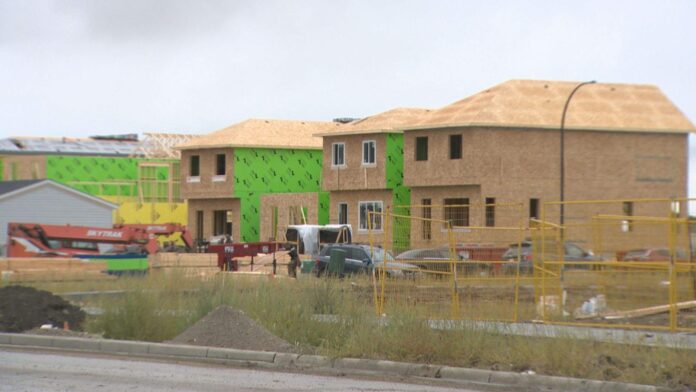
Calgary recorded 27,000 housing starts in 2024 alone — the third consecutive year of record home construction. Current trends suggest the city is on pace to build approximately 19,000 homes in 2025, a figure that, while still above the ten-year historical average, falls short of the annual target required to close the gap entirely.
A Slowdown Already Underway
The deceleration is not incidental. Total housing starts have declined by more than 20 per cent as projects initiated in recent years reach completion and fewer new ones break ground. CMHC attributes the pullback to a confluence of pressures: rising vacancy rates, growing inventories, elevated construction costs, and what the agency describes as “broader economic uncertainty.”
“As a result, we expect supply growth to moderate once the current development pipeline is delivered,” CMHC stated in its report — a warning that the city’s recent gains could prove temporary if the conditions sustaining them are not maintained.
The Rezoning Reversal and Its Consequences
Into this already uncertain picture steps a significant policy shift. Calgary’s current city council voted earlier this year to repeal a citywide rezoning policy that had been adopted under the previous council and took effect in August 2024. That policy had changed the city’s base residential zoning to permit a broader range of housing types — duplexes, rowhomes, townhouses — on a single property without requiring a public hearing. Its repeal will see 306,774 residential properties redesignated back to their original low-density classifications, effective August 2025.
Alex McColl, a board member with More Neighbours Calgary, a housing advocacy organization, acknowledged that the narrowing supply gap is “a good thing,” but expressed concern about what comes next. “This council is riding the momentum created by the previous housing strategy, which is good,” he said. “But repeal without replacement reverses the conditions that increase housing supply.” He warned that the lag between starts and completions means the consequences of today’s decisions will only become visible in two years’ time — and that the direction of travel is already worrying.
Mayor Jeromy Farkas defended the repeal during a question-and-answer session with a local Rotary Club chapter, arguing that the existing infrastructure was insufficient to support a blanket, city-wide approach. “I don’t think, with the infrastructure that’s in the ground, that it was adequate to be able to take a one-size-fits-all approach,” Farkas said. “But that said, we have to continue to build and we have to continue to build the housing that Calgarians can afford.”
A city spokesperson pointed to continued building permit activity in newer communities such as Ricardo Ranch and Alpine Park, as well as in established neighbourhoods like Haysboro and Tuxedo Park, as evidence that construction remains broadly active. “Altogether, Calgary continues to see strong housing construction which is helping to approach a balance between supply and demand,” the city said in a statement.
Looking Ahead: A Narrower Housing Strategy
Beyond the rezoning debate, Calgary city council is preparing to vote on a revised housing strategy that has been significantly scaled back — from 98 recommendations to approximately 10 — with a sharpened focus on non-market housing. The shift signals a reorientation of the city’s approach at a moment when the trajectory of market-rate construction remains uncertain.
For long-time residents like Judy Klassen, the pace of development has itself become a source of unease. “I don’t like it,” she told Global News, gesturing at the density appearing in older neighbourhoods. “Look at all the condos they’re putting up. Even in the older areas, they’re building eightplexes on one lot.” Her discomfort reflects a tension familiar to many Canadian cities: the urgent need for more homes, and the genuine disruption that building them entails for existing communities.
Calgary’s housing story, for now, is one of real progress built on fragile foundations — a supply gap halved by years of exceptional construction, but a policy environment and economic climate that offer no guarantee the momentum will hold.

