
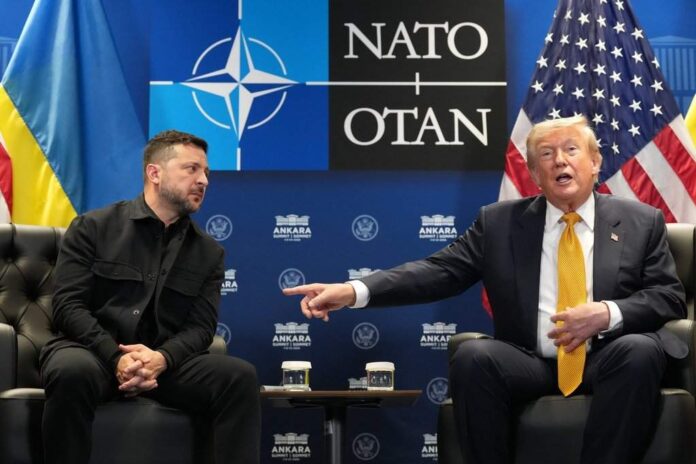
Ukrainian President Volodymyr Zelenskyy has formally asked President Donald Trump to intervene with SpaceX chief Elon Musk and secure expanded access to the Starlink satellite communications network — specifically to guide Ukrainian strikes on targets inside Russian territory. The request, made during an Oval Office meeting this week, represents one of the most sensitive diplomatic asks Zelenskyy has brought to Washington since the full-scale Russian invasion began in February 2022, and it arrives at a moment when Ukraine’s other major defence priorities are running into headwinds from an increasingly distracted American administration.
Musk has permitted Ukraine to use Starlink within its own territory, including in areas currently under Russian occupation, but has maintained a firm restriction on extending the system’s reach across the Russian border. Zelenskyy has been pressing U.S. officials on this question for at least several weeks, and during his Washington visit this week — ostensibly to attend Senator Lindsey Graham’s memorial service — he repeated the request directly to Trump in the Oval Office and again to a group of senators on Capitol Hill the same evening. Two people familiar with the private discussions confirmed the substance of those conversations on condition of anonymity. Trump did not commit to the request. The White House, the Ukrainian Embassy in Washington, and SpaceX did not respond to requests for comment.
The strategic logic behind the Starlink request is straightforward, even if the politics surrounding it are anything but. Senator Mike Rounds, a Republican from South Dakota and member of the Senate Armed Services Committee who was present during Zelenskyy’s Capitol Hill session, explained that Ukraine needs reliable satellite connectivity to make its longer-range and intermediate-range weapons systems meaningfully more accurate. “They prefer to be exactly on target, as opposed to in the general area,” Rounds said, adding that Zelenskyy had made that point with considerable clarity. The Ukrainian president had raised the same issue at the NATO summit in Ankara two weeks earlier, and senators noted the consistency between the two conversations — a consistency that itself signals how central this capability has become to Ukraine’s military planning.
Expanding Starlink’s operational zone into Russia would not be without risk for Musk and his company. Reporting by The Associated Press in December revealed that two NATO-member intelligence services believe Russia is developing an anti-satellite weapon designed to target the Starlink constellation by releasing destructive clouds of shrapnel in low orbit — though the AP was not able to independently verify those conclusions, and the intelligence services involved asked not to be identified. Russia has long regarded Starlink as a grave threat, and the thousands of low-orbiting satellites have been widely credited with giving Ukraine a decisive communications edge throughout the conflict. Granting Ukraine the ability to use that edge offensively, inside Russia itself, would almost certainly intensify whatever pressure Moscow is already applying to the system.
Patriot Commitments Under Review as Interceptor Supplies Tighten
The Starlink request does not exist in isolation — it is partly a response to a growing shortage of the Patriot air defence interceptors that Ukraine relies on to blunt the relentless barrage of Russian missiles and drones targeting Ukrainian cities and infrastructure. Those interceptors are in shorter supply in part because the ongoing U.S. and Israeli military campaign against Iran has drawn heavily on the same stockpiles. Zelenskyy reiterated to senators this week that Ukraine urgently needs more Patriot batteries and, critically, a licensing agreement that would allow Ukraine to begin manufacturing the system domestically — a proposal Trump had appeared to endorse at the NATO summit in Turkey, where he declared that the United States would give Ukraine “the right to make Patriots.”
By Friday, however, Trump appeared to be retreating from that commitment. Speaking to reporters at Camp David, where his Cabinet had gathered, the president described the licensing question as still under discussion and said no decision had been made. “We’re talking about it. But it’s a hard thing to give away that kind of technology,” Trump said — a formulation that contrasted noticeably with the declarative confidence he had projected in Ankara. The shift leaves Ukraine in a familiar position: reliant on American goodwill that can shift quickly, and searching for alternative levers to maintain its defensive capacity.
Zelenskyy has worked to frame Ukraine’s situation not merely as a bilateral issue between Kyiv and Washington, but as one directly connected to American strategic interests in the Middle East. U.S. intelligence has confirmed that Iran supplied Russia with drones used against Ukrainian targets, and more recently, U.S. and European officials have indicated that Russia is preparing to ship upgraded versions of those same drones back to Iran. Zelenskyy told American officials ahead of his visit that he had evidence Russia is assisting Iran in targeting U.S. military bases in the Middle East through satellite surveillance — a claim designed to make Ukraine’s war effort legible in terms that resonate with the Trump administration’s current preoccupations. Senator Richard Blumenthal, a Democrat from Connecticut who also sits on the Armed Services Committee, said Zelenskyy was emphatic about Ukraine’s readiness to contribute more directly to countering Iranian drone capabilities, drawing on battlefield experience that Ukrainian forces have developed over years of confronting the very technology Iran is now deploying more broadly. “He was very emphatic on that point,” Blumenthal said.
The Senate, for its part, advanced a sweeping new Russia sanctions package toward a final vote expected next week, with Zelenskyy having spoken to lawmakers the evening before that procedural vote. Whether the legislative momentum translates into the specific military and technological commitments Kyiv is seeking — Starlink access, Patriot production rights, sustained weapons supply — remains an open question, one whose answer will depend in no small part on how the Trump administration weighs Ukraine’s requests against a set of competing priorities that stretches from the Gulf to the Pacific.

