
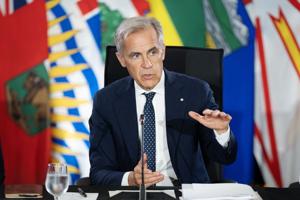
Canada’s response to Donald Trump’s latest tariff escalation will be measured, deliberate, and calibrated to the outcome of trade negotiations over the next several weeks — that is the central message Prime Minister Mark Carney delivered Thursday after a four-hour meeting with provincial and territorial premiers in Charlottetown. The thesis Carney is advancing is not one of passivity, but of strategic restraint: Canada possesses meaningful leverage and knows how to use it, but deploying it prematurely would undermine the very negotiations it is meant to support.
The trigger for Thursday’s gathering was Trump’s announcement Monday of new 50 per cent tariffs on $28 billion worth of Canadian exports — goods that fall under the Canada-United States-Mexico Agreement (CUSMA), the very trade deal Trump signed during his first term. The audacity of that move was not lost on Carney, who drew a direct line between the tariff announcement and the question of American reliability as a negotiating partner. “I have to be convinced. We have to be convinced. The premiers have to be convinced that an agreement is worth the paper it is printed on,” he told reporters at the waterfront hotel where the conference was held. Any new arrangement, he added, must explicitly acknowledge the economic benefits Canada delivers to American workers and industries — not merely to Canadians. The new tariffs are scheduled to take effect on August 19, giving negotiators roughly 27 days to make meaningful progress.
What makes Carney’s position analytically coherent — rather than merely cautious — is that he is managing a genuine diversity of provincial interests without allowing that diversity to fracture the national position. Ontario Premier Doug Ford has called for “dollar-for-dollar” retaliation, reflecting the outsized exposure his province faces from tariffs on manufactured goods and auto parts. British Columbia Premier David Eby has signalled his province’s readiness to offer lumber and mineral resources as bargaining chips, framing sacrifice as strength. Alberta Premier Danielle Smith, by contrast, counselled against leading with threats, and shook her head when asked whether Alberta’s oil assets were being discussed as leverage — a posture that reflects her province’s more complicated relationship with energy trade and American markets. P.E.I. Premier Rob Lantz, as host of the conference, acknowledged the range of views plainly: “While provinces and territories may approach issues in the same way, we sometimes have different priorities or even competing interests.” That Carney emerged from four hours of closed-door deliberation with a unified public message is itself a political achievement worth noting.
Carney also disclosed that Canada had deliberately avoided pursuing smaller, one-off trade concessions with the Trump administration in recent months — a choice that might have offered short-term relief but would have compromised the goal of a comprehensive agreement. “There are other things we could have done in the intervening time that we didn’t do,” he said, without detailing those options. The implication is that Canada’s negotiating position has been preserved precisely because Carney resisted the temptation to trade away leverage piecemeal. On the question of American booze bans — a sore point Washington has raised — Carney was equally firm: removing American beer, wine, and spirits from provincial shelves would only make sense as part of a mutually agreeable broader deal, not as a unilateral goodwill gesture. Ford and Eby both publicly backed that line.
The broader context matters here. Later Thursday, the Trump administration announced yet another round of tariffs, this time targeting more than 60 countries over alleged failures to enforce prohibitions on forced labour in supply chains — with Canada named among those said to have fallen short. Ottawa has maintained that new domestic legislation addresses the issue. Meanwhile, Carney pointed to a parallel strategy of trade diversification, reducing Canada’s structural dependence on the American market by expanding relationships with other partners. “Canada has what the world wants, including being a reliable partner in a world that’s anything but,” he said. The consumer boycott of American goods that has taken hold in parts of the country — reflected in Canadians avoiding U.S. travel, beer, and produce — was acknowledged by Carney as a genuine source of national leverage, one that strengthens Canada’s hand at the table. The implication of his entire posture is clear: Canada enters these negotiations with options, with solidarity, and with the patience to use both wisely.

