
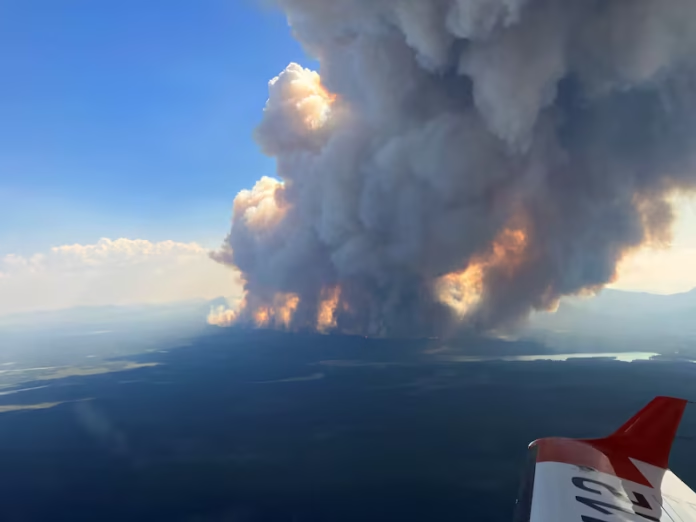
A Season Upended in Hours
British Columbia’s wildfire season underwent a dramatic transformation this past weekend, and the speed of the change underscores a difficult truth about fire management in the province: relative calm can give way to crisis within a matter of hours. On Wednesday morning, firefighters were monitoring roughly 20 active blazes in what had been a comparatively quiet season. By Saturday morning, that number had surged past 113 — approximately 100 of them ignited since Friday alone.
The central thesis here is straightforward but sobering: a single concentrated weather event can overwhelm even a well-resourced provincial fire system, exposing the limits of preparedness when nature moves faster than institutional response. The BC Wildfire Service attributed the vast majority of new fires to approximately 4,000 lightning strikes that struck the province on Friday, a barrage that effectively reset the fire season in a single day.
Two-thirds of the active fires are burning out of control. Most of the new blazes, along with the evacuation orders and alerts that followed, are concentrated in the southern British Columbia Interior — a region that has endured repeated fire seasons with mounting intensity.
Communities Under Pressure
The human consequences of this surge are already being felt across several communities. The Thompson-Nicola Regional District ordered the evacuation of 131 properties near Big Bar Lake and Meadow Lake on Friday, driven by the Fiftynine Creek fire — a lightning-caused blaze that has grown to an estimated 4,000 hectares. Campers at the Big Bar Lake Provincial Park, a campground operating near full capacity, were among those forced to leave as smoke columns rose visibly across the lake.
Near Pemberton, a community of roughly 3,600 residents, the Signal Hill Wildfire was burning approximately one kilometre from a local bed-and-breakfast by Saturday afternoon. Parts of the area south of Pemberton faced evacuation orders while other sections remained on alert — a distinction that carries enormous practical weight for residents trying to decide whether to stay or go.
In Boston Bar, a small Fraser Canyon community of around 160 people, the situation illustrated the difficult personal calculus that evacuation orders force on residents. The Brunswick Creek fire, at 40 square kilometres, and the Ainslie Creek fire, at 160 square kilometres, both bore down on the area. An evacuation order was issued Thursday, yet a local business owner estimated that between 40 and 50 per cent of the community had remained behind — citing the need to protect property, businesses, and animals.
The Scale of Mobilization
The provincial response has been substantial. More than 500 firefighters have been deployed across British Columbia, representing a rapid and significant mobilization triggered by the weekend’s events. That number reflects the scale of the challenge: dozens of fires igniting simultaneously across a vast and rugged landscape strain coordination, equipment, and personnel in ways that a slower-building season does not.
The BC Wildfire Service issued a warning Friday that additional lightning strikes and further fire starts were expected in the coming days. As the weather system moved east into Alberta, officials anticipated that fire activity would continue to intensify. By Saturday afternoon, the tally had reached approximately 114 active fires, with roughly 72 having started in the preceding 24 hours alone.
What this weekend demonstrated is that British Columbia’s fire management infrastructure, however capable, operates under conditions that can shift with startling abruptness. The province’s geography, its climate trajectory, and the growing frequency of extreme weather events combine to ensure that seasons like this one will not be anomalies. The question is not whether such surges will recur, but whether the systems in place — evacuation infrastructure, firefighting capacity, community preparedness — are scaling to meet that reality.

