
A Crisis Arrives Without Warning
The smoke had been building for days before anyone in authority said the word “evacuate.” In late June, Robert Laforge, owner of Lac Des Mille Lodge, watched plumes rise over Byers Lake and began making calls to Ontario’s Ministry of Natural Resources. He kept calling for two weeks. Nobody called back. “They felt like they had it under control,” Laforge said on Saturday. “Not a soul attempted to get a hold of us to let us know the danger that we were possibly in.” By the time ministry officials agreed evacuation was necessary, the roaring fires had already reached the mainland where the campgrounds stood.
Laforge’s experience was not unique. Dale Wirta, owner of Cushing Lake Resort, had gone to bed unaware that fire was already creeping toward his property. A text arrived at 10:15 in the evening: the fire had jumped, and it was close. He had received, by his own account, “zero notification.” He ran from cabin to cabin, fist pounding on doors in the dark. Forty-five minutes after that first text, the neighbouring Thousand Lakes Resort was already burning. Guests who managed to flee described driving through a corridor of fire on both sides of the road, navigating entirely by the red tail lights of the vehicle ahead of them — a scene, Wirta said, that felt like something out of an apocalypse film.
Wirta had been promised that fire crews and property protection teams were on their way. They never arrived. By Wednesday morning, his resort was gone — more than fifty trailers, twelve cabins, two garages, a main lodge, a restaurant, a bar, a convenience store, living quarters. Everything. He did not hesitate to assign blame. “MNR dropped the ball,” he said. “People have lost everything. And it could have all been prevented.” His particular frustration centred on the ministry’s reluctance to order a fire ban in the days before the disaster struck.
Collins First Nation: A Community Erased
The most devastating loss of the week belonged to Collins First Nation, also known as Namaygoosisagagun, a remote community that was burnt entirely to the ground. Videos filmed by teenagers as they fled the fire — crossing a lake by boat, then driving kilometres of bush road through smoke and flames — spread rapidly across social media and brought the crisis to national attention. The images were visceral and frightening. They also raised an immediate and uncomfortable question: why had no one come to help sooner?
Linda Debassige, Grand Chief of the Anishinabek Nation, which represents thirty-nine First Nations including Collins, said the community’s leadership had warned the ministry of the rising risk well in advance, to no avail. “They had to flee this raging inferno with no notice and all by themselves,” she said. Speaking of the viral evacuation footage, Debassige used a word that carried the full weight of the community’s experience: “sacrifice.” It felt, she said, as though Collins First Nation had to burn before nearby communities received faster evacuation orders.
The situation at Collins is further complicated by a jurisdictional gap that has left the community without a safety net. Because it exists in a legal “grey area” as a so-called “near-band” awaiting official recognition from Ottawa, it receives no support from either the federal or provincial government, unlike recognized First Nations. The community built its school, its water plant, its homes and its community buildings without outside assistance over many years. All of it is now gone. Debassige’s ask was not complicated. “It would be nice for them to say, ‘We failed you. We’re sorry. Yes, we should have had early intervention, we should have been monitoring the situation a lot more closely.'”
Nishnawbe Aski Nation Grand Chief Alvin Fiddler was more direct still. In a public post on Saturday, he called on Premier Doug Ford to engage meaningfully with First Nations leadership rather than arriving for appearances. “It’s our people that are being impacted the most by these wildland fires,” Fiddler wrote. “If you are going to make the effort to come up, it can’t just be for a photo op.”
Ford Arrives in Thunder Bay
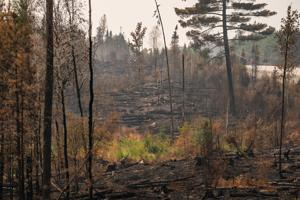
Premier Ford landed in Thunder Bay on Saturday, touching down in a city of just over 130,000 people on the shore of Lake Superior that has become a regional hub for thousands of evacuees displaced from communities across northwestern Ontario. The air was heavy with smoke. Wildfire devastation was visible as close as 150 kilometres to the west, where hundreds of metres of forest had been reduced to scorched earth and charred, broken timber. Ford stood before reporters flanked by Ontario’s natural resources, emergency response and forestry ministers, local Liberal MP Patty Hajdu, and the city’s mayor — a deliberate show of cross-jurisdictional unity.
The premier acknowledged the scale of the emergency plainly. As of Saturday morning, 191 wildfires were burning across Ontario, with 73 not under control. At least ten communities had been evacuated and three more placed on alert. Across Canada, more than 950 wildfires were burning from coast to coast. In total, 655,000 hectares were on fire across the province. “I understand it’s a terrible scenario right now,” Ford told reporters. “But we’re doing absolutely every resource we can possibly throw at this. By no means have we even stalled for a minute on this.”
On the question of spending, Ford was unequivocal, pushing back against opposition criticism that his government had been slow or insufficiently resourced. “Even though they know there’s base funding, right? And then anything over on top of that, there is no limit,” he said. He noted that Ontario spent $271 million on wildfire response last year and indicated the figure could reach $500 million this year without hesitation. “I don’t care what this costs,” he said. The premier’s visit included meetings with first responders and evacuees, though the province released few details about those conversations.
The Ministry’s Defence — and Its Limits
Natural Resources Minister Mike Harris offered a defence of the province’s conduct while leaving room for future improvement. On the specific case of Collins First Nation, he pointed to the physical conditions on the ground as the central obstacle. “Fire actually started very close to the community,” Harris said. “We did our best, obviously, to come and survey what was going on, but there was so much smoke it made it almost impossible for our teams to come in and really assess how close the fire was.” It was an explanation that acknowledged difficulty without fully engaging with the warnings that had reportedly been raised beforehand.
Harris also addressed the challenge of mutual aid between provinces. Alberta and Yukon had offered assistance, and Ontario had made requests to other jurisdictions. But British Columbia, Nova Scotia, the Northwest Territories and several American states were all managing their own active fires, leaving limited capacity to share. The minister offered cautious optimism about the days ahead, noting that fire activity had begun to slow over the previous twenty-four hours. What the province needs most, he said, is sustained rainfall without accompanying lightning — since the majority of current fires were ignited by a single storm system that passed through approximately a week ago.
Thunder Bay at the Breaking Point
Whatever optimism exists in government briefings has not yet reached the streets of Thunder Bay. Mayor Ken Boshcoff said bluntly on Saturday that his city had reached “overcapacity” and would soon need to redirect incoming evacuees to other parts of the province. As a last-resort measure before that redirection begins, the city is preparing to open a local hockey arena as an emergency shelter. “It’s a huge demand all at once, and it looks like there’ll be even more coming,” Boshcoff said. He was careful to thank the province for its support and said he had no complaints — but the arithmetic of the situation spoke for itself.
The larger question hovering over all of it — over the burned resorts, the destroyed First Nation community, the overcrowded shelter city, the ministers and the premier — is whether Ontario and Canada are genuinely prepared for what climate scientists have long described as the new normal of escalating seasonal fire. Grand Chief Debassige put it plainly. “I think it’s bleak,” she said. “I think it’s concerning.” The fires are still burning. The rains have not yet come.

