The numbers are in, and they tell a complicated story.
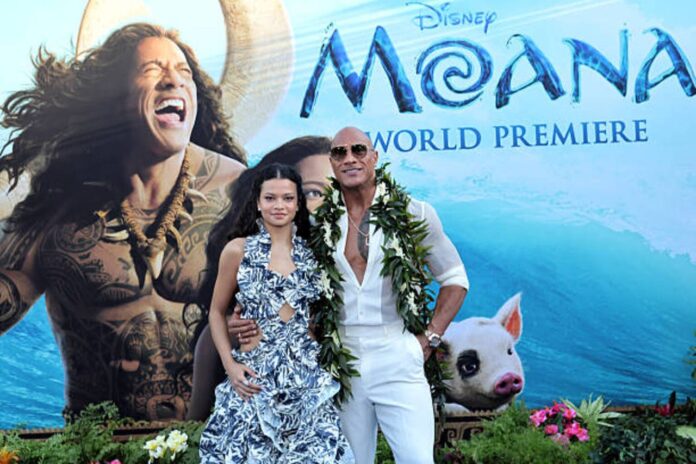
Disney’s live-action reimagining of Moana, starring Dwayne Johnson and newcomer Catherine Laga’aia and directed by Thomas Kail of Hamilton fame, opened this weekend to $43 million across roughly 3,875 to 3,900 North American screens. The studio had projected a domestic debut of $60 million to $65 million, with early tracking suggesting the film might reach as high as $75 million. Instead, it landed well short of those targets — a result that raises real questions about the durability of Disney’s live-action remake strategy.
What exactly happened at the box office?
Internationally, the film earned $52 million, bringing its global opening weekend to $95 million — significantly below the $130 million worldwide figure Disney had hoped for. To put that in perspective, the studio’s more successful live-action adaptations — The Lion King, Aladdin, Beauty and the Beast, and Lilo & Stitch — each debuted above $100 million domestically and eventually crossed the $1 billion mark worldwide. The live-action Moana now sits alongside Snow White ($42.2 million) and Dumbo ($45.99 million) among the weakest openings in that catalogue.
The financial stakes are considerable. The film carries a production budget of $250 million before marketing costs, and with a box office trajectory comparable to Snow White, industry analysts suggest the studio could absorb losses approaching $100 million from its theatrical run alone.
Why did it underperform so sharply?
Timing, more than anything else, appears to be the central culprit. Moana 2 — originally conceived as a Disney+ series before being retooled into a theatrical feature — opened around Thanksgiving 2024 to a staggering $225 million domestic debut over five days and ultimately surpassed $1 billion globally. That success, while welcome for the franchise, created an awkward problem: the live-action remake arrived less than two years later, giving audiences almost no time to develop the nostalgia that typically drives interest in these projects. The original 2016 animated film, for reference, had a full decade to embed itself in popular culture before a remake was even announced.
The original Moana opened to $56.6 million in 2016 and went on to earn $248.7 million domestically and $435.6 million internationally, for a worldwide total of $684.3 million. It remains Disney+’s most-watched feature film, with more than 1.5 billion hours streamed on the platform. Over 22 million toys have been sold and more than 26 billion music streams recorded — figures that confirm the franchise’s enduring hold on its audience, even if that audience may have felt it had already seen enough of Moana’s world in recent months.
How did audiences actually respond to the film?
Here the picture becomes more nuanced. Despite the weak opening, the film earned an A− CinemaScore overall — an A among women and an A+ among viewers under 18, who were notably enthusiastic. The audience skewed heavily female at 66 percent, and 56 percent of ticket-buyers were parents attending with children, a proportion higher than most Disney live-action remakes. On Rotten Tomatoes, critics have been harsh, awarding it just 34 percent, while general audiences have given it a 90 percent approval rating — a gap that suggests the film’s problems are structural and strategic rather than artistic.
Those audience scores matter for the weeks ahead. Strong word-of-mouth from families and young viewers could sustain the film’s run longer than its opening weekend might suggest, particularly given that next weekend brings Christopher Nolan’s R-rated The Odyssey from Universal — a film aimed squarely at a different demographic, which may leave the family-friendly, female-skewing Moana audience with fewer competing options.
What else was happening at the multiplex?
Minions & Monsters from Universal held at second place with $20.5 million in its second weekend — a 45 percent drop that brought its domestic cumulative total to $108.2 million, a solid performance for an animated family film. Pixar’s Toy Story 5 continued its run in third place with $18.5 million in its fourth weekend, down 39 percent, pushing its domestic total to approximately $403.77 million and confirming its status as one of the summer’s most reliable performers.
Evil Dead Burn, the latest entry in Sam Raimi’s long-running horror franchise, directed by Sébastien Vanicek and produced by Raimi alongside Rob Tapert, debuted at fourth with $13.7 million from 3,004 theatres on a lean $20 million production budget — a respectable result for a genre film, though its B CinemaScore suggests more divided audience reactions. Angel Studios’ Young Washington rounded out the top five in its second weekend with $6.44 million, a steep 66 percent decline from its debut, bringing its domestic total to $33.1 million.
What does this mean for Disney’s remake strategy going forward?
The live-action Moana‘s stumble adds to a growing body of evidence that Disney’s formula for mining its animated library is not infinitely elastic. The films that succeeded most handsomely — The Lion King, Beauty and the Beast — benefited from long gestation periods between the original and the remake, allowing genuine anticipation to accumulate. When that gap narrows, or when a sequel has recently refreshed the property in audiences’ minds, the calculus changes considerably. A $250 million production budget demands blockbuster returns, and blockbuster returns, it turns out, require more than a beloved franchise and a recognizable cast. They require patience — something the studio’s release schedule, in this case, did not allow.

