
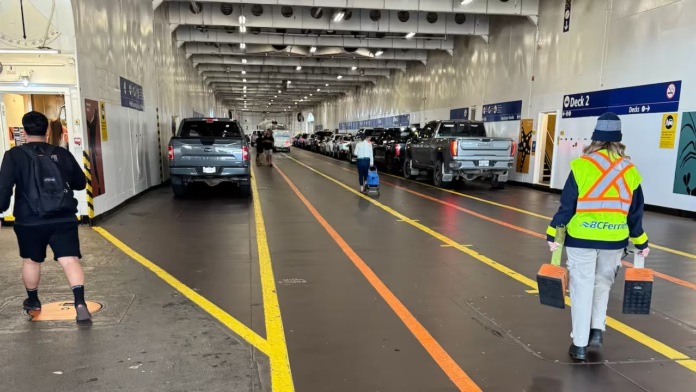
On the morning of July 7, Jessica Price snapped a photograph that told the story more plainly than any press release could. The 11 a.m. sailing from Langdale to Horseshoe Bay was departing with room to spare — visible, frustrating empty space on a vessel that residents had been told was too full to accommodate their bookings. For the communities strung along British Columbia’s Sunshine Coast, that image captured something deeper than a scheduling inconvenience.
A mechanical failure affecting the upper loading ramp at Berth 1 of the Langdale terminal has forced B.C. Ferries to load vehicles exclusively through Berth 2, onto the main vehicle deck only. The result is a sharp reduction in the number of vehicles each sailing can carry. Standby travel has been suspended entirely. Advance reservations are now mandatory in both directions between Langdale and Horseshoe Bay. And some previously confirmed reservations have been cancelled outright.
Initial estimates suggest repairs could take up to ten days, with reduced-capacity operations expected to remain in place through at least July 15. Maintenance crews are working continuously, and the provincial MLA for Powell River–Sunshine Coast, Randene Neill, has indicated that B.C. Ferries hoped to provide an updated repair timeline by Wednesday afternoon. But for residents who depend on this route to reach the mainland, the timeline offers cold comfort.
“That’s our connector to our services, our entertainment, for travelling, everything,” said one Sunshine Coast resident. “It’s not just about people coming here for a beautiful holiday. It’s causing a lot of chaos.”
The disruption has landed with particular weight on those with medical needs. Gibsons Mayor Silas White said he has heard from residents cancelling medical appointments on the mainland — a consequence he described plainly as “a disaster.” He has urged B.C. Ferries to reverse its mandatory reservation policy for Langdale, pointing to a situation that has left some residents stranded on the Vancouver side with no available bookings to return home. “I’ve even heard from people who are stuck on the other side and they’re seeing there’s no availability for them to get back,” White said.
B.C. Ferries has acknowledged the severity of the situation for those with urgent health needs. A spokesperson confirmed that the corporation’s medical assured loading and travel assistance programs remain active, and that people arriving without a reservation for medical reasons can still be accommodated. Ritinder Matthew, B.C. Ferries’ director of communications, said crews are working as quickly and safely as possible to restore full service, and encouraged all travellers to monitor service notices before heading to the terminal.
Still, the frustration is hard to separate from a longer pattern of vulnerability. The Sunshine Coast is not connected to the provincial highway network. The ferry is not a convenience — it is infrastructure. Mayor White has been unequivocal on that point: “It’s not acceptable to our ferry-dependent communities.”
The sight of sailings departing with empty space while confirmed reservation holders wait on shore has sharpened that frustration considerably. The gap between available capacity and actual loading reflects the physical constraints of operating through a single berth — but it is a distinction that offers little reassurance to someone who has missed a specialist appointment or cannot get home.
B.C. Ferries says it is doing everything possible to keep the route running and to prioritize those with the greatest need. For the residents of the Sunshine Coast, the coming days will test that commitment — and, once again, underscore how much the functioning of a single mechanical ramp can determine the shape of daily life for an entire coastal region.

