
Cross-Border Celebration in a Strained Moment
For the fourth consecutive year, the city of Kalamazoo, Michigan, played host to the Can-Am Peace Jam, a festival dedicated to Canadian culture and the enduring friendship between Canada and the United States — and this year, with a trade war grinding on and U.S. President Donald Trump openly musing about annexing Canada as a 51st state, the event carried a weight that previous editions had not. The festival took place on Saturday, organized by Channon Russette-Mondoux, a Windsor, Ontario, native who married an American, settled in Kalamazoo, and has since channelled her Canadian identity into an annual act of cultural diplomacy. Where political rhetoric has strained the relationship between two countries that share the world’s longest undefended border, the Peace Jam held firmly to the proposition that ordinary Canadians and Americans still have more in common than apart.
“Can-Am Peace Jam has always been about connection,” said Russette-Mondoux, who founded the festival. “This year, we’re honoring the stories that traveled with our ancestors — and the new stories we’re creating together as a community.” That sentiment shaped every dimension of the 2025 program, from the music lineup to the cultural programming to the food competitions, and it drew festival-goers into a shared space that felt, by all accounts, both timely and necessary.
This Year’s Theme: The Canadian Diaspora
The 2025 edition organized itself around the theme of “The Canadian Diaspora” — a deliberate effort to celebrate not just Canadian culture in the abstract, but the specific stories, languages, and cultural threads that Canadians have carried across borders and across generations. The festival placed a particular spotlight on the French-Canadian diaspora and its deep, lasting influence on North American art, music, food, industry, and everyday life. That choice of emphasis reflects something real and often underappreciated: the reach of Francophone Canadian culture extends far beyond Quebec’s borders, woven into the fabric of communities across the continent, including in the American Midwest. The programming embraced the full breadth of Canadian heritage — Indigenous, French, and British Commonwealth traditions alike — presenting them not as competing identities but as interlocking threads of a shared story.
Music, Comedy, and Culture
The musical programming drew on both Canadian icons and local talent, with bands performing hits by Rush, Bryan Adams, Alanis Morissette, Avril Lavigne, and Nickelback — a roster that doubles as a fairly comprehensive survey of Canadian rock’s contribution to the global mainstream. The festival’s headline act was Mélisande [électrotrad], an award-winning Montréal quartet sponsored by the Quebec government, whose signature sound fuses traditional Québécois and Acadian folk music with contemporary electronic production. Edmonton-born comedian Henry Sir served as special guest master of ceremonies, bringing regional comedy into the mix alongside an eclectic lineup of local and regional performers spanning Caribbean, Indigenous traditional, classic rock, Celtic, Scottish pipe, and Acadian folk genres. Acts included Zion Lion, Rock RX, Woodland Stream, Full Frontal Cortez, Hen Pecked Dawgs, and The Kalamazoo Scottish Pipe Band — a lineup that illustrated, in practical terms, how capacious the Canadian cultural tent actually is.
Beyond the Stage
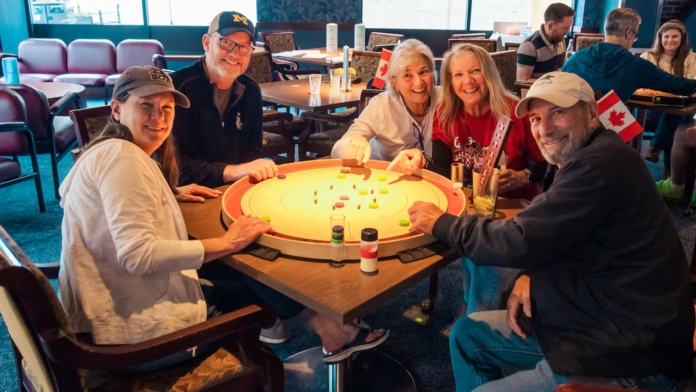
The festival extended well beyond its musical programming, offering attendees a range of cultural experiences that grounded the celebration in everyday Canadian life. Festival-goers gathered around games of crokinole, the traditional Canadian board game that has enjoyed a quiet renaissance in recent years, while others visited a Canadian Citizenship Booth hosted by the Canadian Citizenship by Descent–Bill C-3 Group — a presence that felt particularly pointed given the current political climate, with some Canadian expatriates in the United States reconsidering their options. The event also featured Indigenous ceremonies and art, reflecting the festival’s commitment to acknowledging Indigenous sovereignty and culture as central to any honest account of what Canada is and has been, rather than as an afterthought.
On the culinary front, the festival hosted a World Champion Poutine Competition alongside a Butter Tart Competition open to all entrants, with registration fees directed toward Canadian food banks — a detail that connected the celebration’s festive spirit to a concrete act of solidarity. These competitions, modest as they may seem, served the festival’s broader purpose: making Canadian culture tangible, participatory, and accessible to Americans who might otherwise encounter it only at a distance.
A Change of Venue
The festival had originally been scheduled for Arcadia Creek Festival Place, a beloved downtown Kalamazoo venue that was set to host one of its final major events before redevelopment begins — a bittersweet milestone for the local community. Inclement weather forced organizers to move the event indoors to City Centre Events, a logistical pivot that, by most accounts, did little to dampen the spirit of the occasion. The relocation was a reminder that community events of this kind depend on flexibility and goodwill as much as planning — qualities that, the organizers might argue, are themselves rather Canadian virtues.

