
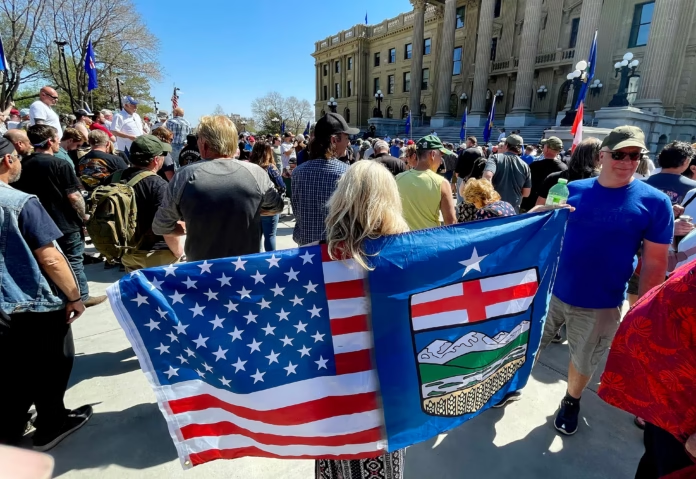
OTTAWA — Reports that Alberta separatist organizers held meetings with senior U.S. officials have set off a wave of political condemnation in Canada and renewed scrutiny of what, legally, would be required for a province to leave Confederation. The controversy has also intensified warnings from Indigenous leaders that treaty rights and constitutional protections cannot be bypassed by a citizen-led push for separation.
Alberta separatist talks with U.S. officials
The Alberta Prosperity Project (APP), an advocacy group promoting Alberta independence, met U.S. State Department officials in Washington three times since April 2025, according to reporting by the Financial Times. The group’s legal counsel, Jeff Rath, told the outlet that APP representatives were pursuing further discussions in early 2026 and intended to raise the idea of a US$500 billion credit facility that could support Alberta in the event an independence referendum were to succeed.
A U.S. State Department official, speaking on background to Canadian media, said the department regularly meets with “civil society” representatives and that no commitments were made in the APP meetings. A White House official made a similar point to the Financial Times, saying such contacts occur with many groups and that no support or commitments were conveyed.
Political backlash in Ottawa and across provinces
The meetings quickly became a flashpoint in Canadian politics. British Columbia Premier David Eby called the reported outreach “treason,” arguing it crossed a line at a time when Canada-U.S. relations are strained. Other premiers criticized the move on sovereignty grounds, while stopping short of the treason label.
Prime Minister Mark Carney said he expects the U.S. administration to respect Canadian sovereignty and noted that President Donald Trump had not raised Alberta separatism in their conversations, according to a Reuters account of his remarks. Alberta Premier Danielle Smith said she supports Alberta remaining in Canada, while acknowledging continued frustration in the province over federal policies.
The referendum drive and what it would take to proceed
The political blowback comes as organizers pursue a citizen-initiative process in Alberta aimed at triggering a provincewide constitutional referendum on independence. Alberta’s Chief Electoral Officer issued the petition for “A Referendum Relating to Alberta Independence” on January 2, 2026, starting a signature-collection period under provincial rules.
A separate analysis circulated in Ottawa policy circles and cited publicly by commentators says the proponent threshold is 177,732 signatures and that the collection window runs 120 days, from January 3 to May 2, 2026.
Constitutional hurdles and the limits of provincial action
Even if an Alberta referendum were held and produced a pro-separation result, Canada’s legal framework sets significant constraints. In its 1998 decision known as the Quebec Secession Reference, the Supreme Court of Canada found that a province cannot secede unilaterally under Canadian constitutional law, while also stating that a “clear majority” vote on a “clear question” in favour of secession would create a duty for governments to enter negotiations. The court emphasized that any move to secede would still require a constitutional amendment.
Parliament’s 2000 Clarity Act, enacted in response to that ruling, sets out a process in which the House of Commons assesses whether a proposed referendum question is clear and whether the result represents a clear expression of the will of the province’s population before the federal government would consider entering negotiations.
In practice, constitutional experts say these requirements mean that a provincial referendum, on its own, would not change Alberta’s legal status within Canada. It would be the start of a political process that must comply with constitutional rules and protect minority rights.
Indigenous leaders warn treaties cannot be sidelined
Indigenous governments in Alberta and across the Prairies have argued that separation campaigns and referendum proposals risk ignoring treaty relationships and constitutional obligations. Several First Nations have said Alberta has a duty to consult and accommodate treaty holders on any process that could affect their rights, and some have taken the issue to court.
Indigenous leaders have also criticized the reported U.S. outreach by separatist organizers, saying it adds a foreign-policy dimension to a domestic constitutional question and raises concerns about outside influence in an already polarized debate.
Foreign interference concerns and the next test for governments
While U.S. officials have denied offering commitments to separatist organizers, the revelation that meetings occurred has sharpened calls for vigilance over foreign interference and disinformation in Canadian democratic processes. The federal government has not alleged wrongdoing by the United States in this case, but the episode has added pressure on Ottawa and provincial authorities to clarify rules and responsibilities as Alberta’s petition drive continues.
For now, Canada’s constitutional architecture remains the central constraint: any attempt to separate would require a clear referendum mandate, negotiations among governments, and constitutional change, with treaty rights and minority protections explicitly in view.

