
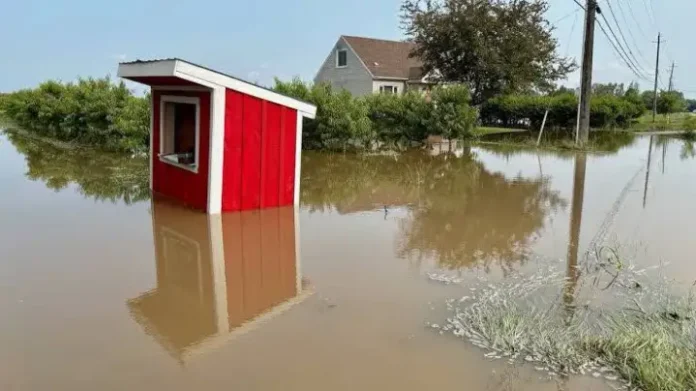
St. Catharines is in shock. Within the span of ten days, three extraordinary rainstorms have battered this Niagara-region city, overwhelming its infrastructure, gutting basements, and leaving residents to drag the waterlogged remnants of their lives to the curb — with no disaster relief from either Queen’s Park or Ottawa in sight.
The sequence of events has been relentless. The first storm struck on July 21. A second, more punishing system moved through from July 27 to 28, triggering widespread flooding across St. Catharines and neighbouring Niagara-on-the-Lake. Then, before residents had finished cleaning up, a third storm hit on Sunday, prompting Mayor Mat Siscoe to declare a state of emergency. The nearby Town of Lincoln, also battered by the back-to-back storms, issued its own declaration under Mayor Sandra Easton. Together, the events dumped a combined 250 millimetres of rain on parts of the region — roughly a quarter of the area’s typical annual precipitation, compressed into just three days.
The human toll is written in soggy drywall and destroyed keepsakes. Billy Hammond took a day off from his job at Canada Post to haul bags of ruined photo albums and family mementos to the curb after sewage backed up into his basement for the second time in less than a week. “We need this garbage out of here because it’s traumatizing to look at,” he said. “It’s like you’re reliving the grief over and over again.” For Hammond and many others, the cruelty of the situation is compounded by its repetition: just as one cleanup neared completion, the second storm arrived to undo it entirely.
Mitch St. Hilaire’s mother and stepfather, who live in the Port Weller area, saw their home flood on July 28 and again on Sunday. Firefighters, meanwhile, have been responding not only to flooded properties but to people trapped in their vehicles by rising water. The city’s emergency operations centre has been running continuously since last Tuesday morning, co-ordinating response efforts, clearing catch basins clogged with debris, and removing obstructions from waterways. Crews are also bracing for additional rainfall forecast later this week.
Mayor Siscoe has been direct about what the city needs and what it has not received. On Sunday night, he posted a video of his own flooded basement to Facebook, describing “a hurricane’s worth” of rain falling in a single evening. By Tuesday, he was standing before reporters with a sharper message: “There has been no disaster relief assistance offered by either the provincial or the federal government. The city has been left to fend for itself.” He is calling on both levels of government to provide immediate assistance and to help municipalities fund the kind of critical stormwater infrastructure upgrades that events like these make unmistakably necessary.
That call touches on a structural tension familiar to many Canadian cities: the gap between the scale of climate-related infrastructure challenges and the fiscal capacity of municipalities to address them alone. Stormwater systems, roads, and sewer networks are largely a local responsibility, yet the storms reshaping Canada’s weather patterns respect no jurisdictional boundary. In St. Catharines, roads, sewer systems, and stormwater infrastructure were all overwhelmed, with significant damage extending to homes, businesses, city facilities, and shoreline areas on both private and public land. The declaration Siscoe issued Monday acknowledged that “Sunday’s storm extended those impacts to even more neighbourhoods across St. Catharines” — meaning the crisis is still widening even as the cleanup begins.
What St. Catharines is living through is not simply a local emergency. It is a signal — arriving with unusual force and unusual frequency — that the infrastructure Canadians depend on was not designed for the weather now bearing down on their communities. The grief Billy Hammond described, the shock spreading across neighbourhoods hit twice in a week, the mayor’s unanswered calls for help: these are not abstract policy problems. They are the lived reality of a city that found itself, in the span of ten days, entirely on its own.

